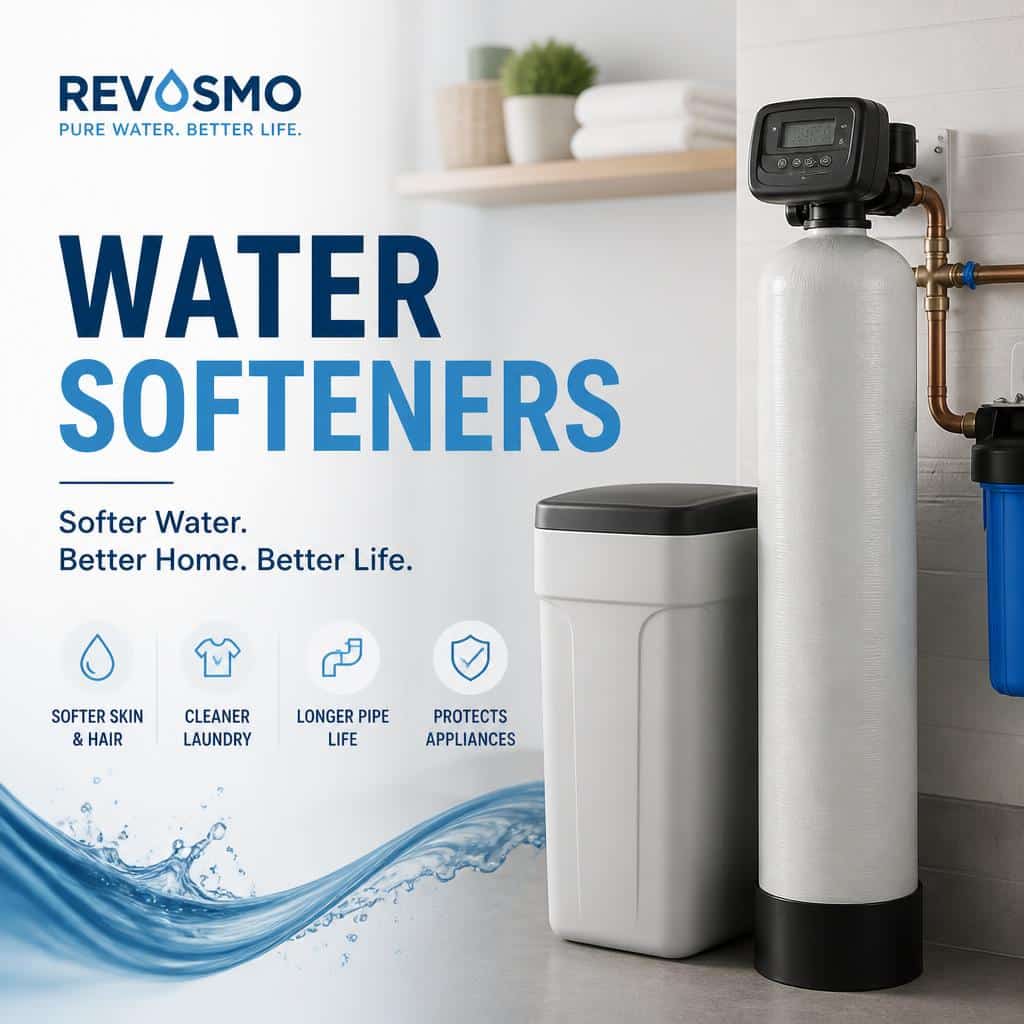
Water Softeners: Hard water is one of the most common water-quality issues homeowners encounter. It can leave white mineral deposits on faucets, create soap scum, reduce lather, contribute to scale buildup inside plumbing, and affect water heaters and appliances.
A water softener is designed specifically to address hardness caused primarily by dissolved calcium and magnesium. Unlike a water filter, which targets specific contaminants, a conventional water softener uses ion exchange to reduce hardness minerals throughout the home.
For homeowners considering a whole-house water treatment system, understanding how water softeners work, when they are necessary, how much they cost to operate, and how they compare with other treatment technologies is important.
This guide explains everything you need to know about residential water softeners, including installation, sizing, maintenance, salt use, alternatives, and how a softener can work alongside a reverse osmosis drinking-water system.
Related guide: See the Whole House Water Filtration Guide for a broader look at whole-house water treatment options.
Table of Contents
- What Is a Water Softener?
- What Is Hard Water?
- What Causes Hard Water?
- How Water Softeners Work
- What Does a Water Softener Remove?
- What a Water Softener Does Not Remove
- Signs You May Have Hard Water
- Water Hardness Levels
- Types of Water Softeners
- Salt-Based Water Softeners
- Salt-Free Water Conditioners
- Dual-Tank Water Softeners
- Demand-Initiated Regeneration
- Benefits of a Water Softener
- Water Softeners and Plumbing
- Water Softeners and Water Heaters
- Water Softeners and Appliances
- Water Softeners and Soap
- Does a Water Softener Make Drinking Water Safe?
- Water Softener vs. Water Filter
- Water Softener vs. Reverse Osmosis
- Can You Use a Water Softener With Reverse Osmosis?
- How to Choose a Water Softener
- How to Size a Water Softener
- Water Softener Efficiency
- Salt Consumption
- Water Consumption During Regeneration
- Water Softener Installation
- Water Softener Maintenance
- How Long Do Water Softeners Last?
- Water Softener Costs
- Are Water Softeners Worth It?
- Water Softener Pros and Cons
- Frequently Asked Questions
- Final Thoughts
What Is a Water Softener?
A water softener is a water-treatment system designed to reduce hardness minerals, primarily calcium and magnesium, from household water.
The most common residential softeners use a process called cation exchange. As hard water passes through a tank containing specialized resin, calcium and magnesium ions are exchanged for sodium or potassium ions.
The result is water with significantly less hardness.
The EPA explains that cation-exchange softeners are specifically intended to remove the calcium and magnesium ions responsible for hard water.
Water softeners are generally installed at the home’s main water line so that softened water can be distributed throughout the house.
Water softeners are different from water filters
A water softener is not simply another type of drinking-water filter.
A conventional softener is primarily designed to address:
- Calcium
- Magnesium
- Water hardness
- Scale formation
A filtration system may instead target:
- Chlorine
- Sediment
- VOCs
- PFAS
- Lead
- Other specific contaminants
The appropriate treatment depends on what is actually present in the water.
What Is Hard Water?
Hard water contains elevated concentrations of dissolved minerals, particularly calcium and magnesium.
These minerals are naturally picked up as water moves through soil, rock, and underground geological formations.
Hardness is generally measured as milligrams per liter (mg/L) of calcium carbonate (CaCO₃) or grains per gallon (GPG).
One grain per gallon is approximately equal to 17.1 mg/L of calcium carbonate.
Common hardness classification
| Hardness | Approximate mg/L as CaCO₃ | Approximate grains per gallon |
| Soft | 0–60 | 0–3.5 |
| Moderately hard | 61–120 | 3.6–7.0 |
| Hard | 121–180 | 7.1–10.5 |
| Very hard | Over 180 | Over 10.5 |
These categories are useful for understanding hardness, although local water suppliers and treatment professionals may use different classifications.
What Causes Hard Water?
Hardness is primarily caused by minerals dissolved into water as it moves through geological formations.
Groundwater is particularly likely to contain elevated hardness because it can remain in contact with mineral-rich rock for extended periods.
Common hardness-producing minerals include:
- Calcium carbonate
- Calcium sulfate
- Magnesium carbonate
- Magnesium sulfate
Water hardness can vary substantially from one community to another—even between nearby cities.
This is why homeowners should test their own water or consult their local water-quality report before purchasing a softener.
How Water Softeners Work
Traditional residential water softeners use ion exchange.
The process generally works like this:
Step 1: Hard water enters the softener
Water from the home’s main supply enters the mineral tank.
Step 2: Water passes through resin beads
The tank contains thousands of small ion-exchange resin beads.
These beads hold positively charged sodium or potassium ions.
Step 3: Calcium and magnesium are exchanged
Calcium and magnesium ions in the incoming water attach to the resin.
Sodium or potassium ions are released into the water.
Step 4: Softened water leaves the tank
The treated water continues into the home’s plumbing system with substantially reduced hardness.
Step 5: The resin eventually becomes saturated
Over time, the resin accumulates calcium and magnesium.
It eventually needs to be regenerated.
Step 6: Regeneration restores the resin
During regeneration, a concentrated salt solution is used to flush the accumulated hardness minerals from the resin and restore its softening capacity.
This regeneration process is one reason traditional water softeners require salt and discharge wastewater.
What Does a Water Softener Remove?
A conventional cation-exchange water softener is primarily designed to reduce water hardness.
It can remove or reduce:
- Calcium
- Magnesium
- Hardness
- Scale-forming minerals
Depending on the system and water chemistry, ion exchange can also affect certain other positively charged ions, but homeowners should not assume that a standard softener is a comprehensive contaminant-removal system.
The EPA specifically identifies cation exchange as a technology for removing hardness ions such as calcium and magnesium.
What a Water Softener Does Not Remove
A standard water softener should not be considered a substitute for comprehensive drinking-water filtration.
A typical softener does not specifically target contaminants such as:
- PFAS
- Chlorine
- Chloramines
- Many pesticides
- Many VOCs
- Microplastics
- Bacteria and viruses
- Nitrate
- Fluoride
- Most dissolved contaminants targeted by reverse osmosis
The exact capabilities depend on the technology and system design.
If your goal is to improve drinking-water quality rather than simply reduce hardness, you may need a separate filtration technology.
For example, reverse osmosis can be used as a point-of-use treatment for drinking and cooking water.
Signs You May Have Hard Water
Common signs of hard water include:
1. White mineral deposits
You may notice white or chalky deposits around:
- Faucets
- Showerheads
- Sinks
- Glass shower doors
- Coffee makers
- Appliances
2. Soap scum
Hard water reacts with soap and can make it more difficult to rinse completely.
3. Poor soap lather
You may need more soap or detergent to produce the desired lather.
4. Scale inside plumbing
Mineral deposits can accumulate inside pipes, fixtures, water heaters, and appliances.
5. Spotty dishes
Dishware and glassware may develop mineral spots after washing.
6. Dry or sticky-feeling skin
Some people notice a different skin feel after showering in hard water.
7. Frequent appliance cleaning
Scale buildup can require more frequent cleaning and maintenance.
EPA guidance notes that hard water can contribute to scale formation in plumbing, water heaters, appliances, and fixtures and can interfere with soap performance.
Water Hardness Levels
Testing your water is the best way to determine whether a softener is appropriate.
A hardness test may report results in:
- Grains per gallon
- mg/L
- ppm as calcium carbonate
For example:
7 GPG × 17.1 ≈ 120 mg/L as CaCO₃
This would generally fall near the boundary between moderately hard and hard water.
Your local water supplier may also provide hardness information in its annual water-quality report.
Types of Water Softeners
Several water-treatment products are marketed as water softeners or conditioners.
The major categories include:
- Salt-based ion-exchange softeners
- Salt-free water conditioners
- Dual-tank softeners
- Demand-initiated regeneration systems
- Specialty systems for well water
Understanding the difference is important because these technologies do not all accomplish the same thing.
Salt-Based Water Softeners
Salt-based softeners are the traditional residential solution for significant water hardness.
They use cation-exchange resin and typically regenerate using:
- Sodium chloride
- Potassium chloride
The major advantage is that they actually remove the calcium and magnesium responsible for hardness.
Salt-based softeners are therefore fundamentally different from many salt-free scale-control products.
Salt-Free Water Conditioners
Salt-free systems are generally designed to reduce or alter the tendency of minerals to form scale rather than remove calcium and magnesium through conventional ion exchange.
They may be attractive to homeowners who want to avoid:
- Salt
- Brine regeneration
- Regeneration wastewater
- Adding sodium through conventional softening
However, homeowners should carefully evaluate product claims and understand whether a system removes hardness or simply controls scale.
EPA’s water-treatment guidance distinguishes between conventional water softeners and scale-reduction technologies and recommends considering appropriate certification for the treatment objective.
Dual-Tank Water Softeners
A dual-tank softener contains two mineral tanks.
This configuration can allow one tank to continue supplying softened water while the other regenerates.
That can be particularly useful for:
- Large households
- High water-demand homes
- Homes that use significant amounts of water throughout the day
- Situations where uninterrupted soft water is desirable
Single-tank systems are sufficient for many households.
Demand-Initiated Regeneration
Older or simpler softeners may regenerate according to a fixed schedule.
Modern systems can instead monitor water usage and regenerate when the system actually needs to do so.
This is called demand-initiated regeneration.
It can reduce unnecessary:
- Salt consumption
- Water consumption
- Regeneration cycles
EPA specifically recommends demand-initiated regeneration when selecting an efficient water softener.
Benefits of a Water Softener
A properly sized and maintained softener can provide several household benefits.
Reduced scale
Softened water can reduce mineral scale in:
- Pipes
- Faucets
- Showerheads
- Water heaters
- Dishwashers
- Washing machines
Better soap performance
Soft water generally allows soap and detergents to work more effectively.
Easier cleaning
Reducing mineral deposits can make:
- Showers
- Sinks
- Faucets
- Glass
- Appliances
easier to clean.
Potential appliance benefits
Reducing scale can help protect appliances that heat water.
EPA notes that scale can decrease heat-transfer efficiency and contribute to appliance and plumbing maintenance issues.
Water Softeners and Plumbing
Hard water can gradually contribute to mineral scale inside plumbing and fixtures.
A softener can reduce the calcium and magnesium responsible for that scale.
However, water chemistry is more complicated than hardness alone. A softener should not be viewed as a universal plumbing-protection system.
Other factors—including pH, alkalinity, temperature, dissolved minerals, and plumbing materials—can affect corrosion and scaling.
Water Softeners and Water Heaters
Water heaters are particularly vulnerable to scale because heating can accelerate mineral deposition.
Scale can accumulate on heating elements and surfaces inside a water heater.
Potential consequences include:
- Reduced heat-transfer efficiency
- Longer heating times
- Increased energy use
- Additional maintenance
- Reduced equipment life
Reducing hardness can help limit scale formation.
Water Softeners and Appliances
Hard water can affect appliances that regularly heat or use water.
Examples include:
- Dishwashers
- Washing machines
- Coffee makers
- Water heaters
- Humidifiers
- Ice makers
A softener can reduce the mineral buildup associated with hard water.
However, appliances may have their own treatment requirements, so always follow the manufacturer’s recommendations.
Water Softeners and Soap
One of the most noticeable benefits of soft water is often the difference in soap performance.
Hardness minerals can interact with soap, creating residues and making it more difficult to produce lather.
With softened water, homeowners may find that they need less soap or detergent for certain household tasks.
This can be particularly noticeable when washing:
- Clothes
- Dishes
- Hair
- Skin
Does a Water Softener Make Drinking Water Safe?
Not necessarily.
A water softener addresses hardness. It does not automatically make contaminated water safe to drink.
If your water contains a contaminant of concern, you need a treatment system specifically designed and appropriately certified for that contaminant.
For example:
- Carbon filtration may address chlorine and certain organic compounds.
- Reverse osmosis can reduce many dissolved contaminants.
- UV treatment can address microorganisms when properly designed and operated.
- Specialized ion-exchange systems can target particular contaminants.
Start with your water-quality report or a laboratory water test before choosing treatment.
For a complete testing strategy, see the How to Test Your Drinking Water guide.
Water Softener vs. Water Filter
Water softeners and water filters solve different problems.
| Feature | Water Softener | Water Filter |
| Primary purpose | Reduce hardness | Remove specific contaminants |
| Calcium | Yes | Depends on technology |
| Magnesium | Yes | Depends on technology |
| Scale reduction | Yes | Depends on technology |
| Chlorine | Generally no | Carbon can reduce it |
| PFAS | Not a standard softener function | Depends on certified technology |
| Sediment | Not primary purpose | Many filters can remove it |
| Lead | Not a standard softener function | Depends on certified technology |
| Drinking-water treatment | Not its primary role | Depends on filter |
| Whole-house treatment | Common | Common |
The key is to match the technology to the water-quality problem.
Water Softener vs. Reverse Osmosis
Reverse osmosis and water softening are often confused because both can reduce dissolved minerals, but they operate very differently.
A water softener primarily exchanges calcium and magnesium ions.
A reverse osmosis system uses a semipermeable membrane and is designed to reduce a much broader range of dissolved substances.
Water softener
Best suited for:
- Hard water
- Scale control
- Whole-house hardness treatment
- Protecting plumbing and appliances from hardness
Reverse osmosis
Best suited for:
- Drinking water
- Cooking water
- Reduction of many dissolved contaminants
- Point-of-use treatment
For a detailed explanation of reverse osmosis technology, see The Ultimate Guide to Reverse Osmosis Systems.
Can You Use a Water Softener With Reverse Osmosis?
Yes.
In fact, combining the two technologies can make sense when a home has both hard water and drinking-water treatment needs.
A common configuration is:
Main water supply → water softener → point-of-use RO system → drinking faucet
The softener addresses hardness throughout the home.
The RO system then provides additional treatment for drinking and cooking water.
Depending on the specific water chemistry and RO system, pretreatment can also be important for protecting membrane performance.
The appropriate configuration should be based on the home’s water-quality results and the specifications of the RO system.
How to Choose a Water Softener
When comparing water softeners, consider more than the advertised grain capacity.
Important specifications include:
1. Water hardness
Know the actual hardness of your water.
2. Household size
More people generally means greater water demand.
3. Peak flow rate
The system must be capable of supplying enough water when multiple fixtures are operating.
4. Grain capacity
The softener’s capacity should match household demand.
5. Salt efficiency
A more salt-efficient system can reduce ongoing operating costs.
6. Water efficiency
Regeneration consumes water, so efficiency matters.
7. Regeneration method
Demand-initiated regeneration is generally preferable to unnecessary fixed-schedule regeneration.
8. Certification
Look for appropriate certification, including NSF/ANSI 44 for residential cation-exchange water softeners.
EPA’s current guidance recommends considering certification and evaluating both water and salt efficiency.
How to Size a Water Softener
Water softeners are typically sized according to:
- Water hardness
- Number of people
- Daily water consumption
- Peak flow
- Regeneration frequency
- Desired reserve capacity
A simplified calculation can help estimate hardness demand.
Example
Suppose:
- 4 people live in the home.
- Each person uses approximately 60 gallons per day.
- Water hardness is 15 GPG.
Daily water use:
4 × 60 = 240 gallons
Daily hardness load:
240 × 15 = 3,600 grains
The actual system size should account for reserve capacity, regeneration settings, manufacturer specifications, and peak demand.
Avoid automatically purchasing the largest available system. Oversizing can increase purchase cost and may result in inefficient operation.
EPA’s water-treatment guidance specifically recommends avoiding unnecessary oversizing.
Water Softener Efficiency
Efficiency is an important consideration when buying a softener.
A system’s efficiency can be evaluated using:
- Gallons of water used during regeneration
- Grains of hardness removed per pound of salt
- Regeneration frequency
- Demand-initiated regeneration
- Total annual salt consumption
EPA guidance identifies an NSF/ANSI 44 voluntary efficiency benchmark of 5 gallons of water or less per 1,000 grains of hardness removed and recommends looking for systems with strong salt efficiency as well.
Salt Consumption
Traditional water softeners require salt or potassium chloride to regenerate the resin.
Salt consumption varies significantly based on:
- Water hardness
- Household water use
- Softener size
- Resin capacity
- Regeneration settings
- System efficiency
A properly programmed system should regenerate based on actual water demand rather than simply regenerating unnecessarily on a fixed schedule.
Water Consumption During Regeneration
Regeneration requires water to flush the resin and remove accumulated hardness minerals.
This means a water softener has an ongoing water-use cost in addition to its salt requirement.
When comparing systems, look for:
- Low gallons per regeneration
- Demand-initiated regeneration
- Efficient resin
- Accurate hardness settings
- Appropriate system sizing
EPA recommends considering water efficiency and salt efficiency together rather than focusing on only one metric.
Water Softener Installation
A typical whole-house softener installation includes:
- Main water supply
- Bypass valve
- Softener control valve
- Mineral/resin tank
- Brine tank
- Drain connection
- Electrical connection, where required
The system is normally installed near the point where the main water line enters the house.
Installation considerations
The installer should consider:
- Plumbing configuration
- Drain location
- Electrical requirements
- Water pressure
- Flow rate
- Local plumbing codes
- Septic-system considerations
- Manufacturer requirements
Some jurisdictions also regulate water-softener discharge or installation, so local requirements should be checked before installation.
Water Softener Maintenance
Routine maintenance helps keep a softener operating correctly.
Check the salt level
Keep an appropriate supply of salt or potassium chloride in the brine tank.
Watch for salt bridges
A salt bridge occurs when salt hardens into a layer that prevents proper brine formation.
Clean the brine tank
Periodic cleaning helps prevent buildup and debris.
Check regeneration settings
Make sure hardness and household-demand settings are appropriate.
Inspect the system
Check for:
- Leaks
- Drain problems
- Error messages
- Unusual noises
- Salt bridging
- Changes in water hardness
EPA recommends periodic maintenance and programming regeneration according to actual water demand and incoming hardness.
How Long Do Water Softeners Last?
The service life of a water softener varies according to:
- Water chemistry
- Household usage
- Resin quality
- Maintenance
- Regeneration settings
- Installation quality
Many residential systems can operate for many years when properly maintained.
Rather than replacing a softener solely because it has reached a particular age, evaluate:
- Water hardness after treatment
- Resin performance
- Control valve condition
- Leaks
- Regeneration performance
- Availability of replacement parts
Water Softener Costs
The total cost of ownership includes more than the initial purchase.
Potential expenses include:
- Equipment
- Installation
- Salt
- Potassium chloride
- Water used during regeneration
- Maintenance
- Repairs
- Replacement components
A cheaper system with inefficient regeneration may cost more to operate over its lifetime than a more efficient system.
When comparing systems, consider total cost of ownership, not just purchase price.
Are Water Softeners Worth It?
A water softener can be useful when a home has significant hardness that is causing:
- Scale
- Appliance problems
- Plumbing buildup
- Soap-related issues
- Cleaning problems
However, not every home needs one.
EPA recommends installing water softeners when water hardness indicates a need rather than automatically installing one in every home.
The best first step is to determine your actual water hardness.
Water Softener Pros and Cons
Pros
- Reduces calcium and magnesium hardness
- Helps reduce scale
- Can improve soap performance
- Can make cleaning easier
- Can help protect water heaters and appliances
- Treats water throughout the home
- Can be paired with other filtration technologies
Cons
- Requires salt or potassium chloride for traditional systems
- Uses water during regeneration
- Requires maintenance
- Has ongoing operating costs
- Does not provide comprehensive contaminant filtration
- May be restricted in some jurisdictions
- Can increase sodium concentration in softened water
EPA notes that regeneration can consume significant amounts of water and salt, making efficiency an important consideration.
Frequently Asked Questions
What is a water softener?
A water softener is a treatment system designed primarily to reduce hardness caused by calcium and magnesium.
Does a water softener remove calcium?
Yes. Conventional ion-exchange softeners remove calcium hardness by exchanging calcium ions for sodium or potassium ions.
Does a water softener remove magnesium?
Yes. Magnesium is one of the primary hardness minerals removed by conventional ion exchange.
Does a water softener remove chlorine?
No. Chlorine removal is generally handled by activated carbon or another technology specifically designed for chlorine reduction.
Does a water softener remove PFAS?
A conventional water softener should not be considered a PFAS treatment system. PFAS treatment requires an appropriately designed and certified technology.
Does a water softener remove lead?
A standard water softener should not be relied upon as a lead-removal system. Lead treatment requires a system specifically certified for lead reduction.
Is softened water safe to drink?
Softened water can be used for drinking in many homes, but sodium levels can increase because conventional softeners exchange calcium and magnesium for sodium. Households with specific dietary or medical concerns should discuss sodium intake with an appropriate healthcare professional and consider whether a separate drinking-water treatment system is appropriate.
Can a water softener remove all minerals?
No. A conventional softener primarily exchanges hardness ions. It does not function like a reverse osmosis system that reduces a much broader range of dissolved substances.
Does a water softener reduce TDS?
Generally, conventional ion-exchange softening does not substantially reduce total dissolved solids because calcium and magnesium are exchanged for sodium or potassium rather than simply removed from the water.
Do water softeners waste water?
Traditional softeners use water during regeneration. More efficient demand-initiated systems can reduce unnecessary regeneration and water consumption.
Can a water softener work with reverse osmosis?
Yes. A whole-house water softener and point-of-use reverse osmosis system can complement one another.
Does a whole-house water filter replace a water softener?
Not necessarily. A whole-house filter may target sediment, chlorine, VOCs, or other contaminants while leaving hardness minerals in the water.
How often does a water softener regenerate?
It depends on water hardness, household consumption, system capacity, and programming. Demand-initiated systems regenerate based on actual usage and remaining capacity.
How often should I add salt?
It depends on the softener, water hardness, household consumption, and regeneration settings. Check the brine tank regularly and follow the manufacturer’s recommendations.
Can I install a water softener myself?
Some homeowners can install basic systems, but installation involves plumbing, drainage, and potentially electrical work. Professional installation can help ensure proper sizing, configuration, and compliance with local requirements.
Final Thoughts
Water softeners are specialized treatment systems designed primarily to solve one problem: hard water.
A conventional ion-exchange softener reduces calcium and magnesium, helping control scale throughout the home and potentially improving the performance of soaps, appliances, plumbing fixtures, and water heaters.
However, a softener should not be confused with a comprehensive drinking-water filtration system. If your water also contains contaminants such as chlorine, PFAS, lead, nitrate, or other substances, you may need additional treatment.
For homeowners planning a complete water-treatment strategy, start by testing the water and identifying the specific problems that need to be addressed.
A common whole-home approach is:
Water testing → whole-house treatment → water softening when needed → point-of-use filtration or reverse osmosis for drinking water
For a broader look at whole-house treatment options, see the Whole House Water Filtration Guide.
For homeowners considering an RO system for drinking and cooking water, see The Ultimate Guide to Reverse Osmosis Systems.