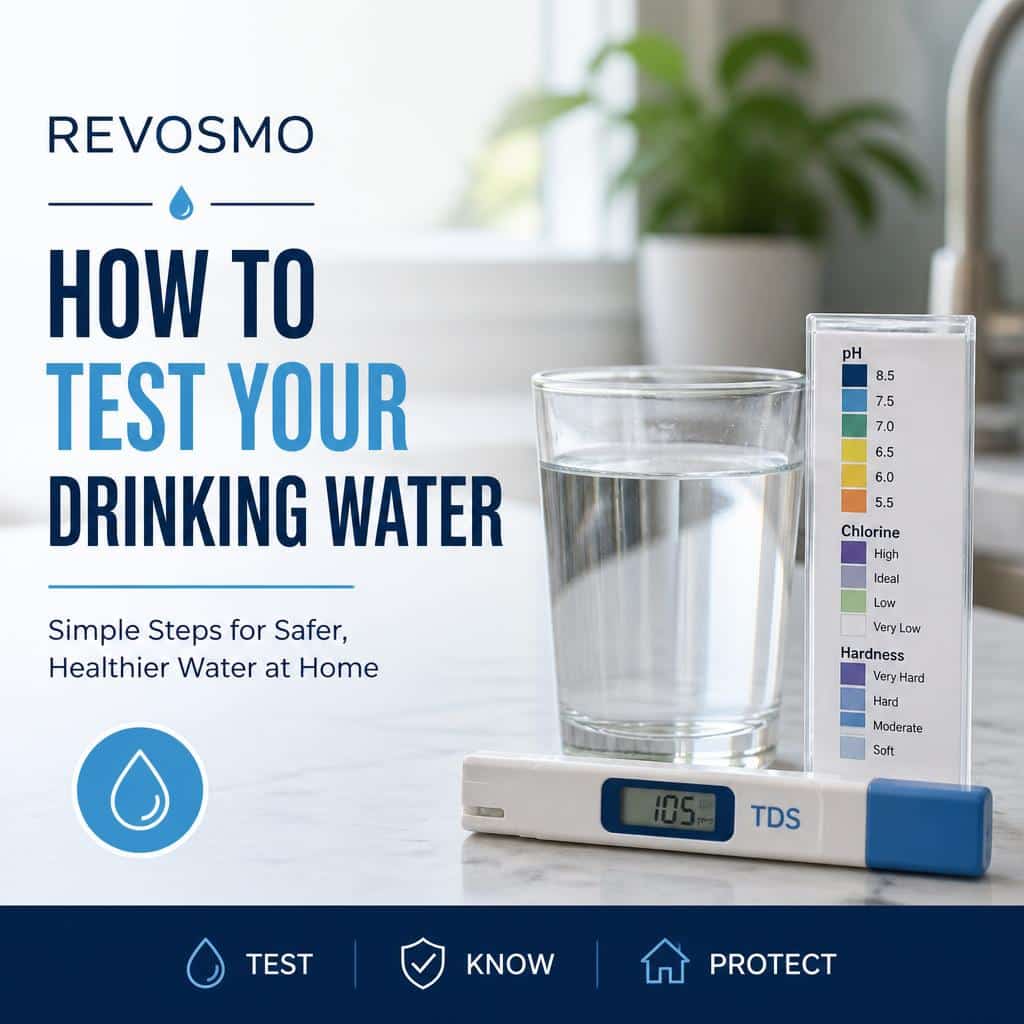
How to Test Your Drinking Water: Knowing what’s in your drinking water is an important part of protecting your household and choosing the right water filtration system.
Your water may come from a municipal water utility, private well, community system, or another source. Each source has different testing requirements and potential concerns. Even if your water comes from a regulated public water system, conditions inside your home—including plumbing, fixtures, and older pipes—can affect the water that actually comes out of your faucet.
The good news is that testing your drinking water doesn’t have to be complicated. You can start by reviewing your local water-quality report, identifying contaminants that may be relevant to your water source, using appropriate home test kits or meters for basic screening, and sending samples to a certified laboratory when more precise testing is needed.
This guide explains how to test drinking water at home, what to test for, when to use a home water test kit versus a laboratory, how to test well water and city water, and how to use your results to make better water-filtration decisions.
Important: A home water test can be useful for screening and monitoring, but not every test kit measures every contaminant reliably. For health-related decisions or contaminants requiring laboratory analysis, use an appropriate state-certified drinking-water laboratory and follow the required sampling instructions. EPA recommends that individuals seeking independent drinking-water testing contact a state-certified drinking-water laboratory.
Table of Contents: How to Test Your Drinking Water
- Why Should You Test Your Drinking Water?
- What Should You Test Your Drinking Water For?
- Start With Your Water Source
- How to Test City Water
- How to Test Well Water
- Review Your Water Quality Report First
- Home Water Test Kits vs. Laboratory Testing
- How to Collect a Drinking Water Sample
- Testing for TDS
- Testing Water Hardness
- Testing for Lead
- Testing for PFAS
- Testing for Bacteria
- Testing for Nitrates
- Testing for Chlorine
- Testing for pH
- Testing for Arsenic and Other Contaminants
- How to Read Your Drinking Water Test Results
- When Should You Send Water to a Laboratory?
- How Often Should You Test Your Drinking Water?
- What to Do When a Water Test Finds a Problem
- Using Water Test Results to Choose a Filter
- Home Drinking Water Testing Checklist
- Drinking Water Testing FAQ
- Final Thoughts
Why Should You Test Your Drinking Water?
Water can look, smell, and taste perfectly normal while still containing contaminants that require testing to detect.
Testing can help you identify problems involving:
- Lead
- PFAS
- Nitrates
- Arsenic
- Fluoride
- Bacteria
- Chlorine
- Chloramines
- Hardness minerals
- Iron
- Manganese
- Copper
- Mercury
- VOCs
- Total dissolved solids
- pH
- Other chemicals or microorganisms
The right testing strategy depends heavily on where your water comes from.
Public water systems are regulated under the federal Safe Drinking Water Act and applicable state requirements. Private wells, on the other hand, are not regulated under the federal Safe Drinking Water Act in the same way public systems are, meaning well owners have a greater responsibility for monitoring their water.
Testing is also useful when you’re considering installing a water filter.
Instead of buying a filtration system based solely on marketing claims, testing can help you determine which contaminants actually need to be addressed.
What Should You Test Your Drinking Water For?
There is no single water test that is ideal for every household.
A sensible testing plan starts with your water source, location, plumbing, potential contamination sources, and specific concerns.
| Water Test | What It Can Tell You | Common Reason to Test |
| TDS | Approximate dissolved-solids level | RO monitoring, mineral content |
| pH | Acidity/alkalinity | Corrosion and water chemistry |
| Hardness | Calcium and magnesium | Scale and water treatment |
| Lead | Lead contamination | Older plumbing or fixtures |
| PFAS | Specific PFAS compounds | Local contamination concerns |
| Nitrate | Nitrate concentration | Well water, agricultural areas |
| Coliform bacteria | Possible bacterial contamination | Private wells |
| Chlorine | Disinfectant level | Taste and odor |
| Arsenic | Arsenic concentration | Groundwater and well concerns |
| Copper | Copper concentration | Plumbing corrosion |
| Iron | Iron concentration | Staining and taste |
| Manganese | Manganese concentration | Groundwater concerns |
| VOCs | Volatile organic compounds | Fuel/industrial contamination |
| Fluoride | Fluoride concentration | Local water chemistry |
| Mercury | Mercury concentration | Specific contamination concerns |
You don’t necessarily need to test for every item on this list.
The objective is to select tests that are appropriate for your particular water source and potential risks.
Start With Your Water Source
Before buying a test kit, determine where your drinking water comes from.
There are three common situations.
City or Municipal Water
If you’re connected to a public water utility, start with the utility’s annual water-quality report.
Community water systems are required to provide customers with annual Consumer Confidence Reports containing information about detected contaminants and the system’s compliance with drinking-water standards.
Your report can help identify contaminants that may be worth testing at your own faucet.
Private Well
Private well owners should take a more proactive approach.
CDC recommends that private well owners test at least annually for:
- Total coliform bacteria
- Nitrates
- Total dissolved solids
- pH
CDC also recommends considering additional testing based on local conditions and potential contamination sources.
Other Water Sources
You may also receive water from:
- A shared well
- Small community system
- Rural water system
- Rainwater collection
- Spring
- Cistern
- Water delivery system
The testing strategy should be adapted to the source.
How to Test City Water
Testing city water involves two separate questions:
- What does the utility say is in the water?
- What’s actually coming out of my home’s faucet?
Start by obtaining your utility’s latest water-quality report.
Then consider testing your own tap water if:
- Your home has older plumbing.
- You are concerned about lead.
- You notice a change in taste, color, or odor.
- You have installed a new filtration system.
- Your home has a private plumbing concern.
- You want to verify a specific contaminant.
- You are considering purchasing a water treatment system.
This distinction is important because a utility’s water-quality report describes the water system’s monitoring results; it does not necessarily tell you exactly what is present at every individual household faucet.
For more information, see the supporting guide Testing City Water.
How to Test Well Water
Private well owners should generally take a more comprehensive approach to testing.
CDC recommends annual testing for:
- Total coliform bacteria
- Nitrates
- Total dissolved solids
- pH
Additional testing may be appropriate for contaminants such as:
- Arsenic
- Lead
- Mercury
- Radium
- Pesticides
- Herbicides
- VOCs
- Other locally relevant contaminants.
You should also consider testing after events that could affect the well, such as:
- Flooding
- Nearby construction
- Changes in water taste or odor
- Changes in water color
- Damage to the well
- Changes in nearby land use
- Septic-system problems
Use a state-certified drinking-water laboratory for laboratory testing.
For a more detailed procedure, see Testing Well Water.
Review Your Water Quality Report First
If you receive municipal water, your annual water-quality report is one of the best places to begin.
A Consumer Confidence Report can tell you:
- Where your water comes from
- Which contaminants were detected
- Reported contaminant concentrations
- Applicable standards
- Whether violations occurred
- Other information about the water system
EPA says community water systems are required to provide Consumer Confidence Reports to customers annually.
The report can help you decide whether additional household testing makes sense.
For example, if your utility report identifies elevated levels of a particular contaminant—or if your area has a known contamination issue—you may want to test your own tap water.
For a detailed explanation of how to interpret these documents, see How to Read a Water Report.
Home Water Test Kits vs. Laboratory Testing
One of the most important decisions is choosing the right testing method.
Home Water Test Kits
Home test kits can be convenient for screening certain basic parameters.
They may test for things such as:
- pH
- Hardness
- Chlorine
- Nitrate
- Nitrite
- TDS
- Certain metals
- Other basic water-quality indicators
However, performance varies substantially among test products and methods.
Laboratory Testing
Laboratory testing is preferable when you need reliable measurements for a specific contaminant or when the results could influence a health decision.
EPA explains that certified drinking-water laboratories use approved analytical methods and quality-control procedures for drinking-water analysis.
For a detailed comparison, see Best Water Test Kits and Home Water Lab Guide.
How to Collect a Drinking Water Sample
Even a high-quality laboratory test can produce misleading results if the sample isn’t collected correctly.
Always follow the laboratory’s sampling instructions.
Depending on the contaminant, instructions may specify:
- Which faucet to use
- Whether to remove an aerator
- Whether to let the water run
- Whether to collect a first-draw sample
- Whether to collect a flushed sample
- The required container
- Required sample volume
- Preservation requirements
- Maximum holding time
- Shipping requirements
This is especially important for contaminants such as lead, where the sampling protocol can affect the result.
Don’t substitute your own collection procedure simply because it is more convenient.
EPA explains that analytical methods address not only measurement but also sample collection, preservation, storage, quality control, and reporting.
Testing for TDS
Total dissolved solids (TDS) is one of the easiest water-quality parameters to measure at home.
A handheld TDS meter can provide a quick numerical reading.
TDS represents the combined concentration of dissolved substances in water, but it does not identify what those substances are.
A high TDS reading doesn’t automatically mean the water is unsafe, and a low TDS reading doesn’t automatically mean the water is safe.
TDS is particularly useful for:
- Monitoring reverse osmosis systems
- Comparing source and filtered water
- Tracking changes over time
- Identifying changes in dissolved-solids levels
For a complete explanation, see TDS Meters Explained.
Testing Water Hardness
Water hardness is primarily associated with dissolved calcium and magnesium.
Hard water can contribute to:
- Scale buildup
- Water spots
- Soap consumption
- Reduced efficiency of some appliances
- Plumbing deposits
Hardness is generally more of a water-treatment and plumbing concern than a direct indicator of overall drinking-water safety.
You can test hardness using:
- Test strips
- Drop-count titration kits
- Laboratory analysis
For more information, see Water Hardness Testing.
Testing for Lead
Lead deserves special attention because you cannot reliably determine whether water contains lead by looking at it, smelling it, or tasting it.
Lead can enter drinking water through plumbing materials and fixtures.
Testing is the appropriate way to determine whether lead is present.
CDC notes that testing is the only way to confirm whether lead has leached into drinking water and recommends using a certified laboratory for testing when lead is a concern.
Lead testing can be especially important if you have:
- Older plumbing
- Older fixtures
- A home built before modern plumbing standards
- Known lead service-line concerns
- Corrosive water
- A child in the household
- A pregnant household member
For a dedicated testing procedure, see Lead Testing.
Testing for PFAS
PFAS are a large group of human-made chemicals that have been used in many industrial and consumer applications.
Testing for PFAS is considerably different from using a basic home water test strip.
EPA has developed laboratory analytical methods for measuring certain PFAS in drinking water, including EPA Methods 533 and 537.1.
If PFAS are a concern in your area, consider:
- Checking local water-quality information.
- Investigating known PFAS contamination sources.
- Selecting a laboratory capable of performing the appropriate PFAS analysis.
- Following the laboratory’s sampling instructions.
- Reviewing the laboratory report carefully.
For more information, see PFAS Testing.
Testing for Bacteria
Bacterial testing is particularly important for private wells.
CDC recommends that private wells be tested at least annually for total coliform bacteria.
You should also consider testing after:
- Flooding
- Well repairs
- Changes in taste or odor
- A sewage or septic problem
- Other events that could introduce contamination
Bacterial testing is more sensitive to sampling and handling procedures than many basic home tests.
Follow the laboratory’s instructions carefully.
Testing for Nitrates
Nitrate testing is especially important for private wells.
Potential sources include:
- Fertilizer
- Agricultural runoff
- Septic systems
- Animal waste
- Wastewater
- Flooding
CDC recommends annual nitrate testing for private wells.
If you live in an agricultural area or near potential nitrate sources, your local health department may be able to recommend additional testing.
Testing for Chlorine
Chlorine testing is commonly performed on municipal water.
Chlorine is used as a disinfectant by many water systems.
A chlorine test can help explain:
- Chlorine taste
- Chlorine odor
- Changes in water chemistry
- Filter performance
Chlorine testing can also be useful when evaluating carbon filtration.
However, chlorine levels can vary throughout a distribution system and over time, so a single test represents conditions at the time and location of sampling.
Testing for pH
pH describes whether water is acidic, neutral, or alkaline.
pH testing can be useful for understanding:
- Corrosion potential
- Water chemistry
- Plumbing concerns
- Well-water characteristics
- Water-treatment requirements
A pH reading by itself does not provide a complete assessment of drinking-water safety.
For example, water can have an acceptable-looking pH while still containing lead, PFAS, arsenic, bacteria, or other contaminants.
Think of pH as one piece of the water-quality puzzle, not a complete water-safety test.
Testing for Arsenic and Other Contaminants
Some contaminants require specialized laboratory testing.
Examples include:
- Arsenic
- Mercury
- Radium
- PFAS
- VOCs
- Pesticides
- Certain industrial chemicals
- Specific microorganisms
The appropriate test depends on your water source and local risks.
Private well owners should contact their local health or environmental department for recommendations about contaminants that may be important in their area. CDC specifically recommends this approach for selecting additional well-water tests.
How to Read Your Drinking Water Test Results
Water test reports can be confusing because laboratories may report results using different:
- Units
- Detection limits
- Reporting limits
- Standards
- Abbreviations
Common units include:
- mg/L
- µg/L
- ppm
- ppb
- CFU/100 mL
Don’t compare numbers without first checking the units.
For example, 1 mg/L is not the same as 1 µg/L.
Also determine whether the laboratory report identifies:
- The measured concentration
- The laboratory reporting limit
- The detection limit
- The applicable drinking-water standard
- The test method
- The sample date
If you don’t understand a result, ask the laboratory or your local health department for help rather than guessing.
For municipal water reports specifically, see How to Read a Water Report.
When Should You Send Water to a Laboratory?
Laboratory testing is usually the better choice when:
- A contaminant could affect health.
- You need an accurate concentration.
- You’re testing for PFAS.
- You’re testing for lead.
- You’re testing for arsenic.
- You’re testing for bacteria.
- You’re testing for VOCs.
- You’re investigating suspected contamination.
- You’re purchasing a home with a private well.
- You’re troubleshooting a serious water-quality problem.
- You’re verifying the performance of a treatment system.
EPA encourages consumers seeking independent drinking-water testing to contact state-certified drinking-water laboratories.
A home test kit can be useful, but it shouldn’t be treated as a universal substitute for laboratory analysis.
How Often Should You Test Your Drinking Water?
Testing frequency depends on your water source and circumstances.
City Water
Start by reviewing your annual Consumer Confidence Report.
Additional household testing may be appropriate if:
- Your home has older plumbing.
- You are concerned about lead.
- You notice a change in water quality.
- Your area has a known contamination concern.
- You install or evaluate a filtration system.
Private Well
CDC recommends annual testing for:
- Total coliform bacteria
- Nitrates
- TDS
- pH
Additional tests should be based on local conditions and potential contamination sources.
After an Environmental Event
Consider additional testing after:
- Flooding
- Wildfires
- Major construction
- Chemical spills
- Septic-system failure
- Well damage
- Changes in nearby land use
What to Do When a Water Test Finds a Problem
Finding a contaminant doesn’t necessarily mean you need to panic.
The next step is to understand:
- What was detected?
- At what concentration?
- What units were used?
- What standard or health benchmark applies?
- Was the sample collected correctly?
- Does the result need confirmation?
- What treatment options are appropriate?
For potentially significant contamination, consult your local health department or an appropriately qualified water professional.
EPA advises that if a contaminant is found above applicable health standards in private-well water, homeowners should contact their public health department and have the well retested to confirm the contaminant and concentration.
Don’t purchase a filtration system simply because a test result contains a large number.
First determine exactly what the number means.
Using Water Test Results to Choose a Filter
One of the biggest benefits of testing your water is that it can help you choose filtration based on actual needs.
For example:
| Test Result | Possible Treatment Direction |
| High TDS | Reverse osmosis may be worth evaluating |
| Hard water | Water softener or appropriate conditioning |
| Lead detected | Certified lead-reduction treatment |
| PFAS detected | Treatment specifically certified for applicable PFAS claims |
| Chlorine | Activated carbon filtration |
| Sediment | Sediment filtration |
| Bacteria in well water | Appropriate disinfection/treatment |
| Iron | Iron-specific treatment |
| Manganese | Manganese-specific treatment |
| Nitrate | Treatment designed and certified for nitrate reduction |
| Arsenic | Arsenic-specific treatment |
The treatment should follow the contaminant—not the other way around.
A reverse osmosis system can be highly useful for certain dissolved contaminants, but RO should not automatically be assumed to solve every water-quality problem.
Check the specific performance claims and certifications of any treatment product you’re considering.
Home Drinking Water Testing Checklist
Use this checklist as a starting point.
Step 1: Identify Your Water Source
- City/municipal water
- Private well
- Shared well
- Other source
Step 2: Research Your Water
- Obtain your annual water-quality report if applicable
- Research local contamination concerns
- Contact your local health department if needed
- Identify potential plumbing concerns
Step 3: Select Tests
- TDS
- pH
- Hardness
- Chlorine
- Lead
- PFAS
- Nitrate
- Bacteria
- Arsenic
- Other locally relevant contaminants
Step 4: Choose the Testing Method
- Home test kit
- TDS meter
- Laboratory test
- State-certified drinking-water laboratory
Step 5: Collect the Sample Correctly
- Follow laboratory instructions
- Use the correct container
- Follow first-draw or flushed-sample instructions
- Observe holding times
- Preserve and ship the sample correctly
Step 6: Evaluate the Results
- Verify units
- Review detection/reporting limits
- Compare with the appropriate standard or benchmark
- Confirm unusual results when appropriate
- Determine whether treatment is necessary
Step 7: Choose Treatment
- Identify the contaminant
- Research appropriate treatment
- Check product performance claims
- Look for applicable independent certification
- Retest after treatment when appropriate
Drinking Water Testing FAQ
What is the best way to test drinking water?
The best method depends on what you’re testing for. Basic parameters such as TDS, pH, hardness, and chlorine can often be screened at home, while contaminants such as lead, PFAS, arsenic, VOCs, and bacteria may warrant laboratory testing.
Can I test my drinking water at home?
Yes. Home water test kits and meters can be useful for certain parameters. However, not all home tests provide laboratory-quality results, so use an appropriate certified laboratory when accurate contaminant measurement is important.
How often should I test my drinking water?
The appropriate frequency depends on the water source. CDC recommends private well owners test annually for total coliform bacteria, nitrates, TDS, and pH. City-water users should start by reviewing their annual utility water-quality report and consider additional household testing when specific concerns exist.
Should I test city water?
You don’t necessarily need to perform a comprehensive test every year if you’re served by a regulated public water system. Start with your utility’s Consumer Confidence Report, then consider household testing for specific concerns such as lead, plumbing-related contamination, or a known local contaminant.
Should I test well water?
Yes. Private well owners are responsible for monitoring their own water. CDC recommends annual testing for total coliform bacteria, nitrates, TDS, and pH, along with additional testing based on local conditions.
What is the most important water test?
There isn’t one universally most important test. The appropriate tests depend on your water source and local risks. For private wells, annual testing for coliform bacteria, nitrate, TDS, and pH is a useful baseline.
Is a TDS meter enough to test drinking water?
No. A TDS meter measures dissolved solids but does not identify individual contaminants. A low TDS reading does not prove that water is free of lead, PFAS, bacteria, arsenic, or other contaminants.
Can a water test tell me whether my water is safe?
A properly designed laboratory test can provide valuable information about specific contaminants, but no single basic test measures everything that could affect water quality. A meaningful assessment requires testing for contaminants relevant to your particular water source and circumstances.
Where can I get my drinking water tested?
For independent laboratory testing, EPA recommends contacting a state-certified drinking-water laboratory. Your state or local health department can also help identify appropriate laboratories.
How do I know which contaminants to test for?
Start with your water source, local water-quality information, your utility’s water report if applicable, and potential contamination sources. For private wells, your local health department can help identify contaminants of concern in your area.
Should I test my water before buying an RO system?
Yes, especially if you’re trying to determine which treatment technology you need. Testing can help identify the contaminants that need to be reduced and prevent you from buying a system based solely on generic filtration claims.
Does filtered water need to be tested?
Testing filtered water can be useful when you want to verify treatment performance or investigate changes in taste, odor, or other characteristics. For important contaminant claims, use appropriate testing methods and follow the treatment manufacturer’s recommendations.
Final Thoughts
Testing your drinking water is one of the best ways to make informed decisions about your home’s water quality and filtration needs.
The most important point is that there is no single test that tells you everything about your water.
Start with your water source. If you’re on city water, review your utility’s annual water-quality report. If you use a private well, establish a regular testing program and pay particular attention to bacteria, nitrates, TDS, and pH.
For basic measurements, home test kits and TDS meters can be convenient tools. For contaminants such as lead, PFAS, arsenic, bacteria, and other substances where accuracy matters, use an appropriate laboratory and follow its sample-collection instructions.
Once you know what’s in your water, you can make much better decisions about filtration.
The goal isn’t to test everything simply because you can. The goal is to test intelligently, understand the results, and choose water treatment based on actual water-quality needs.
Explore Revosmo’s supporting guides for more detailed information on [Best Water Test Kits], [TDS Meters Explained], [How to Read a Water Report], [Testing Well Water], [Testing City Water], [Water Hardness Testing], [PFAS Testing], [Lead Testing], and [Home Water Lab Guide].