How to Read a Water Report: Your local water utility publishes a water quality report every year, but knowing where to find the report is only the first step. The real challenge is understanding what all those numbers, abbreviations, contaminant names, and regulatory limits actually mean.
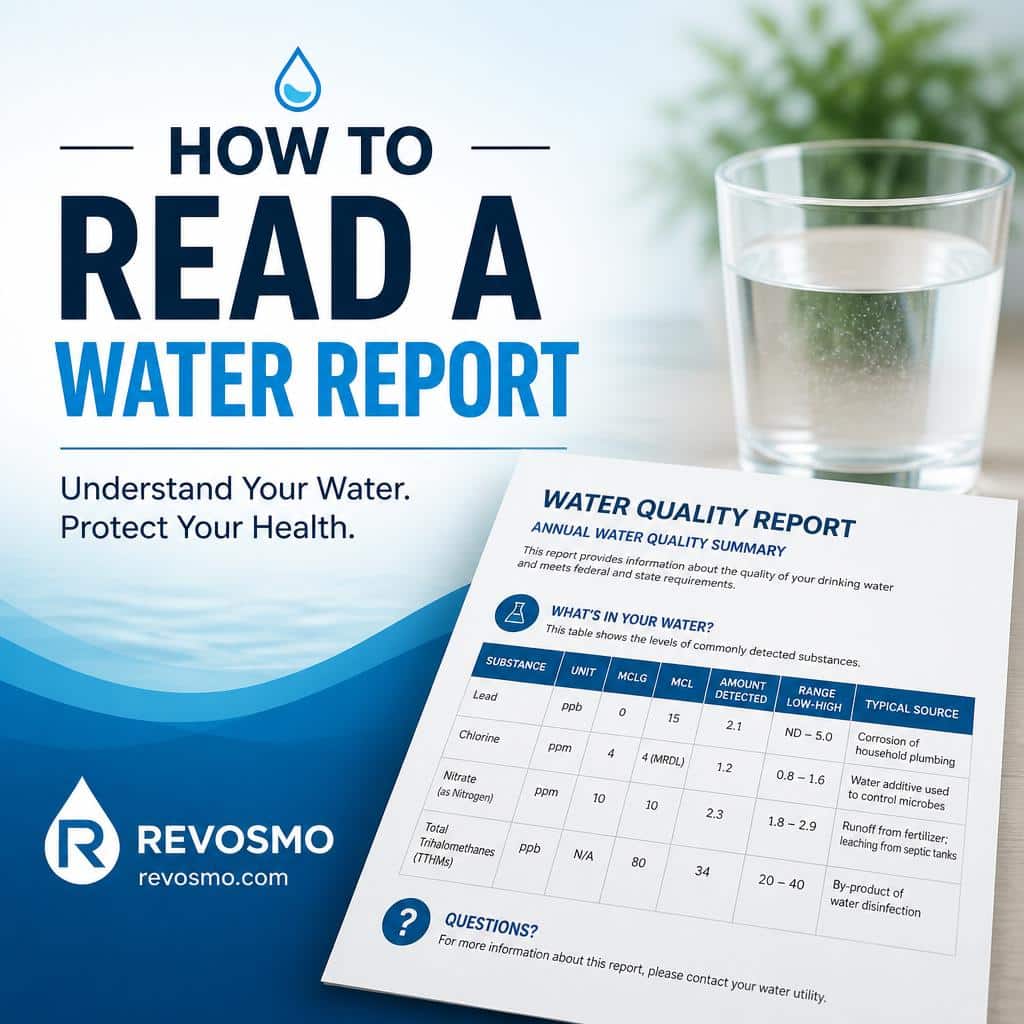
A typical water quality report, also called a Consumer Confidence Report (CCR), contains information about where your drinking water comes from, which regulated contaminants were detected, how much was detected, and whether the water system complied with applicable drinking-water standards.
Learning how to read a water report can help you determine whether your water may have issues that deserve additional testing or whether a home water filtration system could improve its quality, taste, or appearance.
In this guide, we’ll explain exactly what to look for in a water quality report, how to interpret contaminant levels, and what to do when the report raises questions about your drinking water.
Table of Contents: How to Read a Water Report
- What Is a Water Quality Report?
- Where to Find Your Water Quality Report
- What Information Is Included in a Water Report?
- How to Read the Water Quality Data Table
- Understanding MCL and MCLG
- What Does “Your Water” Mean?
- What Does “Range” Mean?
- Understanding Sample Dates
- What Does “Violation” Mean?
- Understanding Action Levels and Treatment Techniques
- How to Read Common Water Contaminants
- Parts Per Million vs. Parts Per Billion
- Does a Water Report Tell You if Your Water Is Safe?
- Why Your Water Report May Not Tell the Whole Story
- What to Do If You Find a Contaminant
- Do You Need a Water Filter?
- Water Reports and Reverse Osmosis Systems
- Questions to Ask About Your Water Report
- Frequently Asked Questions
- Final Thoughts
What Is a Water Quality Report?
A water quality report is an annual report that provides information about the quality of water supplied by a public water system.
In the United States, these reports are commonly called Consumer Confidence Reports (CCRs).
The report is designed to give consumers information about their drinking water, including:
- The source of the water
- Contaminants detected during testing
- The concentration of detected contaminants
- Applicable drinking-water standards
- Potential health effects
- Water treatment information
- Compliance information
- Contact information for the water utility
Community water systems are required to provide consumers with an annual report, generally by July 1.
The report is an important starting point for understanding your local water supply, but it isn’t necessarily a complete analysis of the water coming out of the faucet in your home.
Where to Find Your Water Quality Report
If you receive municipal water, start with your local water utility.
Search for:
“[Your Water Utility] Consumer Confidence Report”
You can also contact the utility directly and request the most recent report.
The EPA provides resources for finding Consumer Confidence Reports and information about local public water systems.
If you use a private well, the situation is different. Private wells are not regulated in the same way as public water systems, and homeowners are generally responsible for arranging appropriate testing.
For more information about testing options, see Revosmo’s How to Test Your Drinking Water guide.
What Information Is Included in a Water Report?
Although reports vary in design, a typical Consumer Confidence Report may contain several important sections.
1. Water Source
The report should identify where the water comes from.
Possible sources include:
- Rivers
- Lakes
- Reservoirs
- Groundwater
- Aquifers
- Purchased water from another utility
Knowing your water source can provide useful context because different sources can have different water-quality characteristics.
2. Water Treatment
The report may explain how the water is treated before it reaches your home.
Treatment can include processes such as:
- Filtration
- Disinfection
- Chlorination
- Chloramination
- Coagulation
- Sedimentation
- Other treatment processes
3. Detected Contaminants
This is usually the most important section for homeowners.
It lists regulated contaminants that were detected during required monitoring and provides measurements that can be compared with applicable standards.
4. Health Information
The report may explain potential health effects associated with contaminants that were detected above applicable standards or otherwise require additional explanation.
5. Compliance Information
Look for information about violations, corrective actions, or other regulatory requirements.
A report showing no violations means the water system met applicable regulatory requirements during the reporting period. It does not mean that every possible contaminant was absent.
How to Read the Water Quality Data Table
The contaminant table can look intimidating at first.
You may see columns such as:
| Column | What It Means |
| Contaminant | Substance being measured |
| MCLG | Maximum Contaminant Level Goal |
| MCL | Maximum Contaminant Level |
| Your Water | Level measured in the water system |
| Range | Lowest and highest reported measurements |
| Sample Date | When the sample was collected |
| Violation | Whether an applicable standard was exceeded |
| Typical Source | Common source of the contaminant |
The exact terminology can vary depending on the contaminant and the regulatory requirements.
The key is to read the columns from left to right rather than focusing on a single number.
Understanding MCL and MCLG
Two of the most important abbreviations you’ll encounter are MCL and MCLG.
What Is an MCL?
MCL stands for Maximum Contaminant Level.
It represents the highest level of a regulated contaminant that is allowed in drinking water under the applicable federal drinking-water standard.
MCLs are legally enforceable standards for public water systems.
What Is an MCLG?
MCLG stands for Maximum Contaminant Level Goal.
An MCLG is a health-based goal representing a contaminant level at or below which there is no known or expected risk to health, allowing for a margin of safety.
Unlike an MCL, an MCLG is not an enforceable standard.
Why Are MCL and MCLG Different?
An MCLG focuses primarily on health protection.
An MCL considers health protection along with factors such as treatment technology, feasibility, and cost.
This is why an MCL and MCLG may be different numbers.
What Does “Your Water” Mean?
The Your Water column shows the concentration of the contaminant measured in the water supply according to the reporting requirements for that contaminant.
Depending on the contaminant, the value may represent a single measurement, an average, a percentile, or another regulatory calculation.
This is important because you shouldn’t automatically assume that the number represents the exact concentration coming out of your kitchen faucet at every moment.
Water quality can change over time and can also be affected by household plumbing.
What Does “Range” Mean?
A water report may provide a range showing the lowest and highest detected concentrations during the reporting period.
For example:
| Contaminant | Your Water | Range |
| Example Contaminant | 2.5 ppb | 1.2–4.8 ppb |
In this example, the reported measurements ranged from 1.2 ppb to 4.8 ppb.
Looking at the range can be useful because a single reported value doesn’t always show how much the measured concentration varied.
Understanding Sample Dates
Always look at the sample date or reporting period.
A water report is not necessarily a real-time snapshot of your water.
Some contaminants are monitored frequently, while others may be tested less often.
A report may therefore contain data collected months before you read it.
If you have a specific concern about your current drinking water, consider conducting your own water test rather than relying solely on an older utility report.
What Does “Violation” Mean?
The Violation column tells you whether the water system exceeded an applicable regulatory requirement.
If a report identifies a violation, look for additional information explaining:
- What happened
- Which contaminant was involved
- How long the problem lasted
- Potential health effects
- What corrective action was taken
A violation is something that deserves attention, but the appropriate response depends on the contaminant, concentration, duration, and applicable standard.
If you see a violation involving a contaminant of concern, contact your water utility or state drinking-water authority for more information.
Understanding Action Levels and Treatment Techniques
Not every contaminant is regulated using an MCL.
Some contaminants use an Action Level (AL).
An Action Level is a concentration that triggers additional treatment or other requirements when exceeded under the applicable regulation.
Lead and copper are examples where action levels are important.
You may also encounter Treatment Technique (TT).
A Treatment Technique is a required process intended to reduce a contaminant when an MCL is not used in the same way.
The important takeaway is simple:
Don’t assume every contaminant should be evaluated using the same type of limit.
Always read the definitions provided with the specific water report.
How to Read Common Water Contaminants
Water quality reports can contain dozens of contaminants, but some categories appear frequently.
Lead
Lead is particularly important because it can enter drinking water through plumbing materials and fixtures.
When reviewing lead information, pay close attention to whether the report discusses an Action Level or the 90th percentile.
A public water system’s lead reporting can therefore look different from a simple “average concentration.”
If you’re concerned about lead in your own home, testing the water at the tap can provide information that a utility-wide report cannot.
Chlorine and Chloramines
Chlorine and chloramines are disinfectants used to control microorganisms in drinking water.
Some homeowners notice these disinfectants because they can affect:
- Taste
- Odor
- Shower water
- Skin feel
- Drinking-water flavor
Carbon filtration is commonly used to reduce chlorine and can also be effective against certain other water contaminants, depending on the filter design.
Fluoride
Fluoride may appear on your water report if it is naturally present or added to the water supply.
If you’re evaluating filtration options, check the specifications of the individual filter rather than assuming that every carbon filter or water purifier removes fluoride.
Nitrate
Nitrate can be associated with agricultural activity, fertilizer use, septic systems, and other sources.
Nitrate is particularly important for households with infants because elevated nitrate levels can pose serious health concerns.
If nitrate appears in your water report, compare the reported concentration with the applicable drinking-water standard and consider additional testing if you have concerns.
Arsenic
Arsenic can occur naturally in groundwater and can also enter water supplies through certain industrial and agricultural activities.
If arsenic appears in your water report, pay close attention to the reported concentration and applicable standard.
Specific filtration technologies may be required to reduce arsenic effectively.
PFAS
PFAS are a large group of synthetic chemicals that have received increasing attention because of their persistence and widespread occurrence.
A traditional water report may not provide all the PFAS information a homeowner wants, particularly if the utility is not required to report a particular compound or if the data predates newer requirements.
If PFAS is a concern, consider dedicated water testing.
Parts Per Million vs. Parts Per Billion
Water reports use very small measurement units.
Two of the most common are:
ppm — parts per million
ppb — parts per billion
A simple way to visualize the difference is:
- 1 ppm = approximately 1 milligram per liter
- 1 ppb = approximately 1 microgram per liter
Because contaminants can be present at extremely low concentrations, water reports may use ppb or even smaller units.
Don’t Compare Numbers Without Checking the Units
For example, 5 ppm is not equivalent to 5 ppb.
Always check the unit before deciding whether a number is high or low.
Does a Water Report Tell You if Your Water Is Safe?
A water report is extremely useful, but it does not answer every possible question about the water in your home.
A public water report primarily describes the water system and its regulatory monitoring.
Your home’s water can be affected by:
- Household plumbing
- Lead-containing fixtures
- Copper pipes
- Water heater conditions
- Plumbing age
- Water stagnation
- Changes in source water
- Local plumbing problems
This is one reason that a utility report should be considered a starting point rather than the only source of information.
Why Your Water Report May Not Tell the Whole Story
There are several important limitations to keep in mind.
The report represents the water system
The report generally describes the public water system rather than the exact water coming from your kitchen faucet.
Testing frequency varies
Different contaminants are monitored according to different requirements.
Not every possible contaminant is listed
A water report is not the same thing as a comprehensive laboratory analysis.
Household plumbing matters
Contaminants can sometimes enter water after it leaves the treatment plant.
Conditions can change
Water chemistry, source water, treatment operations, and infrastructure can change over time.
For these reasons, homeowners with specific concerns may benefit from additional testing.
What to Do If You Find a Contaminant
Don’t panic if you see a contaminant listed on your water report.
The word detected does not automatically mean the water is unsafe.
Instead, work through these steps:
1. Identify the Contaminant
Find out exactly what was detected.
2. Check the Units
Determine whether the measurement is reported in ppm, ppb, mg/L, pCi/L, or another unit.
3. Find the Applicable Standard
Look for the MCL, MCLG, Action Level, Treatment Technique, or other applicable benchmark.
4. Compare the Reported Level
Determine how the reported concentration compares with the applicable standard.
5. Check the Sample Date
Find out when the water was tested.
6. Look for a Violation
Review the report’s compliance information.
7. Consider Additional Testing
If the contaminant is a particular concern—or if you want to know what’s actually present at your faucet—consider an appropriate home water test.
For a step-by-step guide, see How to Test Your Drinking Water.
Do You Need a Water Filter?
A water report can help you decide whether filtration deserves further consideration.
However, the correct filter depends on the contaminants you want to reduce.
Different technologies target different water-quality problems.
| Water Concern | Potential Treatment |
| Chlorine | Activated carbon |
| Sediment | Sediment filtration |
| Hardness | Water softener |
| Many dissolved contaminants | Reverse osmosis |
| Certain microorganisms | UV or appropriate disinfection |
| Specific contaminants | Contaminant-specific filtration |
This is only a general guide. Always verify that a specific filtration product has been tested or certified for the contaminant you want to reduce.
Water Reports and Reverse Osmosis Systems
If your water report identifies multiple dissolved contaminants, reverse osmosis (RO) may be one filtration technology worth investigating.
RO systems use a semipermeable membrane to reduce many dissolved substances from water.
However, not every RO system performs identically.
Performance depends on factors such as:
- Membrane quality
- Water pressure
- Water temperature
- Incoming water chemistry
- Pretreatment
- Filter condition
- System design
If you’re considering reverse osmosis, see Revosmo’s The Ultimate Guide to Reverse Osmosis Systems for a detailed explanation of RO technology, system components, filtration performance, and what to consider when choosing a system.
A water report can be a valuable starting point for determining what contaminants you should investigate before selecting a filtration system.
Questions to Ask About Your Water Report
If you’re having difficulty interpreting your report, ask your water utility:
- Where does my drinking water come from?
- What contaminants were detected?
- What were the highest reported concentrations?
- How frequently is each contaminant tested?
- Were any regulatory violations reported?
- Were there any recent changes to the water source?
- Are there additional water-quality testing results available?
- Are there known concerns about lead in local plumbing?
- Are PFAS or other emerging contaminants being monitored?
- Where can I obtain the most recent laboratory data?
The utility’s customer service or water-quality department should be able to provide additional information.
Frequently Asked Questions
What is a Consumer Confidence Report?
A Consumer Confidence Report, or CCR, is an annual drinking-water quality report provided by community water systems. It provides information about the source of the water, regulated contaminants detected, applicable standards, and compliance information.
How often should I read my water report?
At least once a year when your utility releases its latest report. Reviewing the report annually can help you notice changes in your local water supply.
Where can I get my local water report?
Start with your water utility’s website or customer-service department. You can also use EPA resources to locate Consumer Confidence Reports.
Does a water report show every contaminant in my water?
No. A Consumer Confidence Report is not necessarily a comprehensive laboratory analysis of every possible contaminant.
What does MCL mean?
MCL means Maximum Contaminant Level. It is the highest level of a regulated contaminant allowed in drinking water under the applicable federal standard.
What does MCLG mean?
MCLG means Maximum Contaminant Level Goal. It is a non-enforceable health-based goal representing a contaminant level below which there is no known or expected risk to health, allowing for a margin of safety.
What does “Your Water” mean on a water report?
The “Your Water” value represents the concentration reported for the water system according to the applicable monitoring and reporting requirements. Depending on the contaminant, it may not represent a single instantaneous measurement at your home’s faucet.
Does a water report tell me whether I need an RO system?
Not by itself. The report can help identify potential water-quality concerns, but choosing a filtration system requires understanding the specific contaminants involved and the capabilities of the treatment technology.
Should I test my water even if my water report looks good?
If you have a specific concern about your home’s water, additional testing may still be appropriate. Household plumbing can affect water quality after water leaves the treatment plant.
Final Thoughts
Learning how to read a water report gives you a much better understanding of what is actually happening with your local drinking water.
Start by identifying your water source, then examine the contaminant table. Pay particular attention to the contaminant name, reported concentration, units, applicable MCL or other standard, sample date, range, and violation information.
Most importantly, remember that a water quality report describes the public water system—it isn’t necessarily a complete analysis of the water coming from your individual faucet.
If you have concerns about a specific contaminant, the next step is often additional water testing.
Read Revosmo’s How to Test Your Drinking Water guide to learn which testing methods are available, what different water tests measure, and how to determine which type of testing is appropriate for your home.
If your testing indicates that filtration is necessary, your results can also help you determine which treatment technology makes sense. For homeowners considering reverse osmosis, Revosmo’s The Ultimate Guide to Reverse Osmosis Systems provides a deeper look at how RO systems work and what to consider before buying one.