
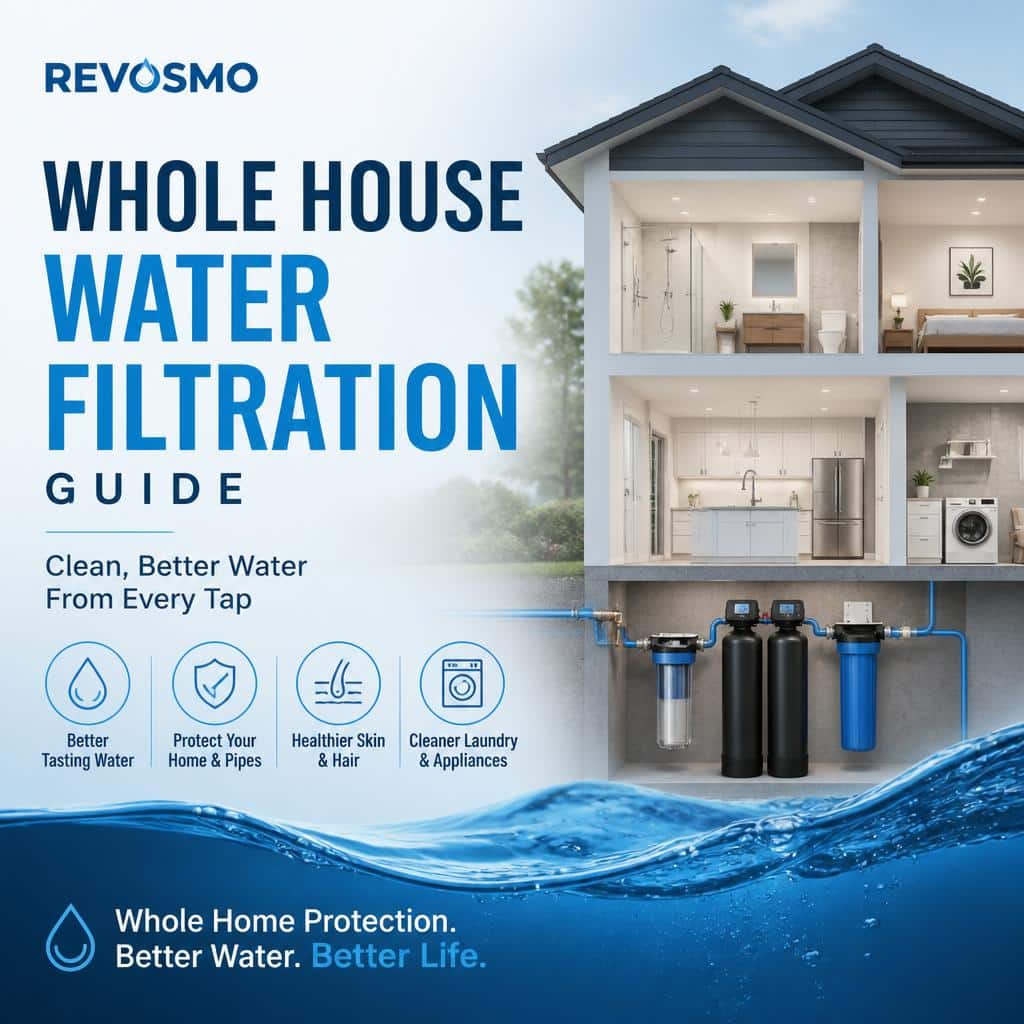
Whole House Water Filtration Guide: A whole house water filtration system can provide treated water throughout your home, from the kitchen and bathroom to showers, laundry rooms, and other fixtures. Unlike an under-sink filter that treats water at one faucet, a whole-house system is installed on the main water line and treats water before it reaches your household plumbing.
But choosing the right whole house water filtration system isn’t as simple as buying a filter with the most stages or the highest price.
Different water-treatment technologies are designed to solve different problems. Sediment filters target suspended particles. Activated carbon can reduce chlorine, taste, odor, and certain organic compounds. Water softeners address hardness minerals. Specialty systems can treat iron, manganese, or other contaminants. UV systems can disinfect water, while reverse osmosis can provide more extensive treatment for drinking water.
The best system depends on what is actually in your water.
The CDC recommends testing your water and choosing a treatment system based on the specific chemicals or germs you are concerned about. It also notes that different treatment systems have different capabilities and that multiple treatment technologies may sometimes be needed. (CDC)
This Whole House Water Filtration Guide explains how whole-house filtration works, which technologies are available, how to choose a system for city or well water, what to consider before installation, how to maintain your equipment, and when combining whole-house treatment with reverse osmosis makes sense.
Table of Contents: Whole House Water Filtration Guide
- What Is Whole House Water Filtration?
- How Does Whole House Filtration Work?
- Whole House vs. Under-Sink Water Filtration
- Why Consider Whole House Water Filtration?
- What Can a Whole House Water Filter Remove?
- The Main Types of Whole House Water Treatment
- Whole House Carbon Filters
- Water Softeners
- Iron Removal Systems
- Sediment Filters
- UV Water Purification
- Well Water Filtration Systems
- City Water Filtration Systems
- RO + Whole House Combination Systems
- How to Choose the Right Whole House System
- Testing Your Water Before Buying a System
- Understanding Flow Rate and Water Pressure
- Understanding Filter Micron Ratings
- Whole House Water Filter Installation
- Whole House Filter Maintenance
- How Much Does Whole House Water Filtration Cost?
- Common Whole House Filtration Mistakes
- Whole House Water Filtration Checklist
- Frequently Asked Questions
- Final Thoughts
1. What Is Whole House Water Filtration?
Whole house water filtration is a water-treatment approach that treats water at or near the point where it enters your home.
The technical term is point-of-entry (POE) treatment.
Instead of filtering only the water coming from your kitchen faucet, a whole-house system can treat water supplied to most or all of your home’s fixtures.
Depending on the system, treated water may be supplied to:
- Kitchen faucets
- Bathroom faucets
- Showers
- Bathtubs
- Washing machines
- Dishwashers
- Ice makers
- Water heaters
- Other household fixtures
The EPA describes point-of-entry systems as treatment devices installed where water enters a building so that treated water can be distributed throughout the property. (US EPA)
A whole-house system can be relatively simple or highly customized.
For example:
Water Main → Sediment Filter → Carbon Filter → Home
A more complex well-water system might look like:
Well → Sediment Filtration → Iron Treatment → Carbon → UV → Home
The correct configuration depends on the water source and the specific problems identified through testing.
2. How Does Whole House Filtration Work?
There is no single type of “whole house filter.”
Instead, whole-house water treatment combines different technologies to address different water-quality issues.
Sediment filtration
Sediment filters physically capture suspended particles such as:
- Sand
- Dirt
- Silt
- Rust
- Pipe scale
Activated carbon
Carbon filtration uses adsorption to capture certain compounds and is commonly used to improve:
- Chlorine
- Taste
- Odor
- Certain organic contaminants
Water softening
Water softeners use ion exchange to reduce hardness minerals, primarily calcium and magnesium.
Specialty media
Specialized filtration media can be designed to address problems such as:
- Iron
- Manganese
- Sulfur compounds
- Certain dissolved contaminants
Ultraviolet purification
UV systems use ultraviolet light to inactivate microorganisms.
Reverse osmosis
Reverse osmosis forces water through a semipermeable membrane and can reduce many dissolved contaminants, depending on the system and membrane.
The EPA identifies activated carbon, ion exchange, reverse osmosis, nanofiltration, and UV-related technologies among the treatment options used for different drinking-water challenges. (US EPA)
The important takeaway is:
There is no universal whole-house filter that removes everything.
3. Whole House vs. Under-Sink Water Filtration
Before buying a whole-house system, determine whether you actually need to treat every gallon entering your home.
Whole-house filtration
A whole-house system treats water at the point of entry.
It may make sense when you want to address a water-quality issue throughout the house.
For example:
- Chlorine affecting shower water
- Sediment throughout the plumbing
- Hard water
- Iron staining
- A contaminant present throughout the household water supply
Under-sink filtration
An under-sink system is a point-of-use (POU) system.
It treats water at a particular faucet, usually in the kitchen.
POU systems can make sense when your primary goal is highly treated water for:
- Drinking
- Cooking
- Coffee
- Ice
- Food preparation
The CDC specifically distinguishes whole-home point-of-entry systems from point-of-use systems and recommends considering where treated water is actually needed. (CDC)
Do you need both?
Sometimes.
A homeowner might use:
Whole House Filtration → RO at Kitchen Sink
The whole-house system addresses water throughout the property, while RO provides additional treatment for drinking and cooking water.
4. Why Consider Whole House Water Filtration?
Whole-house treatment can address several different household concerns.
Better taste and odor
Chlorine and certain other compounds can affect the taste and smell of tap water.
Activated carbon is commonly used to improve these characteristics.
Reduced sediment
Sediment can enter a home’s water supply from:
- Municipal infrastructure
- Private wells
- Aging plumbing
- Corrosion
- Construction
- Well-system changes
A sediment filter can capture suspended particles before they enter household plumbing.
Hard water treatment
Hard water contains elevated concentrations of calcium and magnesium.
It can contribute to:
- Scale buildup
- Mineral deposits
- Soap scum
- Water spots
- Reduced soap performance
- Appliance scaling
A water softener is generally used when hardness is the primary problem.
Iron and manganese
Private wells can sometimes contain elevated iron or manganese.
These minerals may cause:
- Orange or brown stains
- Black or dark staining
- Metallic tastes
- Deposits
Specialized treatment may be necessary.
Microbial concerns
Private wells can sometimes require disinfection treatment.
UV systems can be part of an appropriately designed treatment train when microbial contamination is a concern.
Specific chemical contaminants
Depending on the contaminant, treatment may involve:
- Activated carbon
- Ion exchange
- Specialty media
- Reverse osmosis
- Other validated treatment technologies
The correct technology depends on the contaminant and its concentration.
5. What Can a Whole House Water Filter Remove?
This is where homeowners need to be particularly careful.
A whole-house filter should never be assumed to remove every contaminant.
Different technologies have different capabilities.
| Water Quality Issue | Potential Treatment |
| Sand | Sediment filtration |
| Dirt | Sediment filtration |
| Rust particles | Sediment filtration |
| Chlorine | Activated carbon |
| Taste and odor | Activated carbon |
| Chloramine | Catalytic carbon or appropriate specialty media |
| Hardness | Water softener |
| Iron | Iron removal system |
| Manganese | Specialty treatment |
| Sulfur odor | Appropriate oxidation/media treatment |
| Bacteria | Validated filtration or disinfection |
| Viruses | Appropriate membrane/disinfection technology |
| PFAS | Certified carbon, RO, ion exchange, or other appropriate treatment |
| Lead | Certified lead-reduction treatment |
| Arsenic | Appropriate specialty media or RO |
| Nitrate | Appropriate ion exchange or RO |
| Dissolved solids | RO or other appropriate treatment |
These are treatment categories, not guarantees.
The performance of a particular system depends on its design, flow rate, contact time, water chemistry, contaminant concentration, maintenance, and manufacturer specifications.
Always check the specific product’s performance claims and applicable certification.
The CDC recommends checking a treatment system’s label to determine which chemicals or germs it is designed to remove. (CDC)
6. The Main Types of Whole House Water Treatment
The most common whole-house treatment technologies include:
- Carbon filtration
- Water softening
- Iron removal
- Sediment filtration
- UV purification
- Well-water treatment
- Municipal-water treatment
- Reverse osmosis combinations
These aren’t necessarily competing options.
A properly designed system can combine several technologies.
For example:
Sediment → Carbon → Softener → UV
or:
Sediment → Specialty Media → Carbon → UV
The right sequence depends on the source water and treatment objectives.
7. Whole House Carbon Filters
Activated carbon is one of the most common technologies used in residential water filtration.
Carbon has a highly porous structure that provides a large surface area for adsorption.
Whole-house carbon filtration is often used to address:
- Chlorine
- Taste
- Odor
- Certain organic compounds
- Some disinfection byproducts
The EPA describes granular activated carbon as a porous adsorption medium used to remove certain contaminants from water. (US EPA)
Carbon tank vs. carbon cartridge
A whole-house carbon system may use:
- A large carbon-media tank
- Replaceable carbon cartridges
- Carbon block technology
Large media tanks can provide substantial contact time and are commonly used for whole-house applications.
Important consideration
Carbon can also remove disinfectants.
If your municipal water contains chlorine or another disinfectant, removing that disinfectant throughout the home’s plumbing can change the microbial environment in the plumbing system.
The CDC specifically notes this consideration when using whole-home filters that remove disinfectants. (CDC)
Supporting guide: See Whole House Carbon Filters guide for a deeper look at carbon media, chlorine and chloramine reduction, carbon capacity, flow rates, and maintenance.
8. Water Softeners
A water softener is designed primarily to address hard water.
Hardness comes primarily from calcium and magnesium.
Traditional ion-exchange softeners replace hardness ions with other ions, typically sodium or potassium.
Signs of hard water
You may notice:
- White mineral deposits
- Scale on faucets
- Spots on dishes
- Soap scum
- Poor soap lather
- Scale inside water heaters
- Mineral buildup around shower fixtures
Water softener vs. filter
These are not interchangeable.
A sediment filter removes particles.
A carbon filter targets certain chemicals and compounds.
A softener targets hardness minerals.
If hardness is the problem, adding a more expensive “multi-stage filter” does not necessarily solve it.
Supporting guide: See Water Softeners guide covers hardness testing, softener sizing, salt-based vs. alternative systems, maintenance, and water-softening costs.
9. Iron Removal Systems
Iron is particularly common in private-well water.
It can produce:
- Orange staining
- Brown stains
- Metallic taste
- Sediment
- Discoloration
Iron treatment can be complicated because the form of iron in the water matters.
Treatment may involve:
- Oxidation
- Aeration
- Specialty filtration media
- Chemical treatment
- Filtration
- Combination systems
A basic sediment filter may capture particulate iron but may not effectively address dissolved iron.
That’s why testing should come before choosing an iron-removal system.
Supporting guide: See Iron Removal Systems guide for more information about iron testing, treatment technologies, system sizing, and well-water applications.
10. Sediment Filters
Sediment filtration is frequently used as the first stage of a whole-house treatment system.
Its purpose is to capture suspended particles.
Common targets include:
- Sand
- Dirt
- Silt
- Rust
- Pipe scale
- Other suspended particles
Why use a sediment filter first?
Sediment can clog or reduce the performance of downstream equipment.
A properly selected pre-filter can help protect:
- Carbon media
- Water softeners
- UV systems
- RO systems
- Plumbing fixtures
- Appliances
Common sediment filter types
Residential systems may use:
- Spin-down filters
- Washable screens
- Pleated cartridges
- Melt-blown cartridges
- String-wound cartridges
- Other cartridge designs
The best choice depends on the particle size and amount of sediment in your water.
Supporting guide: See Sediment Filters guide for a detailed comparison of micron ratings, cartridge types, spin-down filters, replacement schedules, and well-water applications.
11. UV Water Purification
Ultraviolet purification uses UV light to inactivate microorganisms.
UV treatment can be particularly useful for certain private-well applications.
However, UV is fundamentally different from carbon filtration.
Carbon removes or reduces certain substances through adsorption.
UV disinfects by exposing microorganisms to ultraviolet radiation.
UV does not remove dissolved chemicals.
The CDC notes that UV systems work better when water is pre-filtered because particles can interfere with UV treatment. (CDC)
A well-water system might therefore use:
Sediment → Filtration → UV
rather than relying on UV alone.
Supporting guide: See UV Purification guide for information about UV systems, sizing, flow rates, lamp replacement, pre-filtration, and well-water applications.
12. Well Water Filtration Systems
Well water requires a different approach from municipal water because the homeowner is responsible for understanding and treating the water source.
Potential well-water concerns include:
- Bacteria
- Nitrate
- Arsenic
- Iron
- Manganese
- Sulfur
- Hardness
- Sediment
- pH
- Other naturally occurring contaminants
There is no universal “well water filter.”
The appropriate system depends on laboratory results.
A typical well-water treatment train could look like:
Well Pump → Sediment Filter → Specialty Treatment → Carbon → UV → Home
But this is only an example.
Some wells may need only sediment filtration.
Others may require several treatment technologies.
Supporting guide: See Well Water Systems guide for a detailed explanation of well-water testing, treatment options, system design, maintenance, and common well-water problems.
13. City Water Filtration Systems
Municipal water is treated before it reaches your home.
Public water systems may use processes such as:
- Coagulation
- Filtration
- Sedimentation
- Disinfection
- Other treatment processes
Disinfectants such as chlorine or chloramine can remain in the distribution system to help control microbial growth in pipes. (CDC)
This means city-water homeowners should not automatically assume they need extensive whole-house filtration.
Instead:
Step 1: Review your water report
Find out what your local utility reports about water quality.
Step 2: Identify your concerns
You may care about:
- Chlorine taste
- Chloramine
- Hardness
- Sediment
- Lead from household plumbing
- PFAS
- Other contaminants
Step 3: Test when appropriate
Home or laboratory testing can provide additional information.
Step 4: Choose treatment
Select technology based on the actual problem.
A carbon system may make sense for chlorine taste and odor.
A softener may make sense for hardness.
A specialized system may be necessary for a particular contaminant.
Supporting guide: See City Water Systems guide for more information about municipal water reports, chlorine, chloramine, plumbing-related contaminants, and whole-house treatment options.
14. RO + Whole House Combination Systems
Whole-house filtration and reverse osmosis do not have to be competing approaches.
In fact, combining them can make sense when different treatment objectives exist.
A common arrangement is:
Main Water Supply → Whole House Treatment → RO at Kitchen Faucet
The whole-house system can address water-quality issues throughout the home.
The RO system then provides additional treatment for drinking and cooking water.
Reverse osmosis can reduce many dissolved contaminants, but system performance depends on the specific membrane and configuration. The EPA notes that point-of-use RO can potentially address contaminants including lead, VOCs, PFAS, arsenic, bacteria, and viruses, with performance depending on the specific system. (US EPA)
Why use RO only at the point of use?
RO systems typically produce a treated-water stream and a reject-water stream. This makes point-of-use treatment practical for drinking and cooking without necessarily treating every gallon used throughout the house. (US EPA)
For a comprehensive explanation of RO technology, membranes, system components, maintenance, and performance, see:
The Ultimate Guide to Reverse Osmosis Systems
Supporting guide: See RO + Whole House Combination Systems guide for system configurations, installation considerations, pretreatment, and when combining the two technologies makes sense.
15. How to Choose the Right Whole House System
The best whole-house system starts with your water—not the product catalog.
Use this process.
Step 1: Identify your water source
Determine whether your home uses:
- Municipal water
- Private well water
- Shared well water
- Another source
Step 2: Review available water information
For municipal water, review the utility’s water-quality report.
For private wells, review previous laboratory results.
Step 3: Test the water
Test for the characteristics and contaminants relevant to your situation.
Step 4: Identify your treatment goals
Are you trying to:
- Improve taste?
- Reduce chlorine?
- Reduce chloramine?
- Remove sediment?
- Reduce hardness?
- Remove iron?
- Address a health-related contaminant?
- Control microorganisms?
- Protect appliances and plumbing?
Step 5: Match treatment to the problem
Do not choose a filter simply because it has multiple stages.
Every treatment stage should serve a purpose.
Step 6: Evaluate system capacity
Consider:
- Household size
- Number of bathrooms
- Peak water demand
- Flow rate
- Water pressure
- Pipe size
Step 7: Evaluate maintenance
Determine:
- Filter replacement frequency
- Media replacement requirements
- Salt requirements
- UV lamp replacement
- Service requirements
- Long-term operating costs
Step 8: Check certifications
Where applicable, look for independent certification for the specific contaminant-reduction claim you need.
The EPA and CDC both emphasize checking product claims and certifications rather than assuming a filter removes substances simply because it is marketed as a water purifier or filtration system. (CDC)
16. Testing Your Water Before Buying a System
One of the most important rules of residential water treatment is:
Test first. Treat second.
Buying a filtration system before understanding your water can lead to an expensive system that doesn’t address your actual problem.
Start by asking:
What is my water source?
City water and well water present different treatment considerations.
What does my water report say?
Municipal utilities publish water-quality information.
What problems am I experiencing?
Consider:
- Taste
- Odor
- Staining
- Scale
- Sediment
- Cloudiness
- Pressure changes
What contaminants concern me?
Potential concerns vary by location and water source.
For health-related contaminants, professional laboratory testing may be appropriate.
What treatment does the test result justify?
This is the point where filtration technology enters the decision.
The CDC’s basic recommendation is straightforward: test your water and choose a system that removes the harmful chemicals or germs you are concerned about. (CDC)
17. Understanding Flow Rate and Water Pressure
A whole-house system must be large enough to supply your home without creating excessive pressure loss.
Consider a situation where several fixtures operate simultaneously:
- Two showers
- Kitchen faucet
- Washing machine
- Dishwasher
The filtration system must be capable of handling the household’s peak demand.
Important specifications
When comparing systems, look for:
- Maximum flow rate
- Recommended flow rate
- Minimum operating pressure
- Maximum operating pressure
- Connection size
- Pressure drop
- Media capacity
A system that provides excellent filtration but severely restricts household water pressure may not be a good fit.
Bigger isn’t always better
An oversized system may cost more than necessary.
The goal is to match system capacity to actual household demand.
18. Understanding Filter Micron Ratings
Micron ratings describe the size of particles a filter is designed to capture.
You may encounter ratings such as:
- 20 micron
- 10 micron
- 5 micron
- 1 micron
- 0.5 micron
However, micron ratings should not be compared without understanding how the manufacturer defines the rating.
There is a difference between nominal and absolute filtration ratings.
The CDC notes that an absolute 1-micron filter has pores at or below that size, whereas nominal or mean ratings can allow larger particles through. (CDC)
A lower micron rating is therefore not automatically better.
A very fine filter can also:
- Restrict flow
- Clog faster
- Increase maintenance
- Increase pressure loss
Choose the rating based on your water and treatment objectives.
19. Whole House Water Filter Installation
Whole-house treatment equipment is generally installed on the main water line entering the home.
A simplified configuration is:
Water Main → Shutoff → Filtration/Treatment → Home Plumbing
Depending on the equipment, the installation may also require:
- Bypass valves
- Pressure gauges
- Drain connections
- Electrical connections
- Brine tanks
- UV controllers
- Media tanks
- Floor drains
- Additional shutoff valves
DIY installation
Simple cartridge systems may be manageable for an experienced DIY homeowner.
Professional installation
Professional installation may be preferable when the system involves:
- Multiple treatment tanks
- Water softeners
- UV
- Drain plumbing
- Electrical equipment
- Chemical injection
- Major plumbing modifications
Always follow local plumbing requirements and the manufacturer’s installation instructions.
20. Whole House Filter Maintenance
A filtration system is only as effective as its maintenance program.
Depending on the technology, maintenance may include:
- Replacing filter cartridges
- Backwashing media
- Replenishing salt
- Replacing carbon
- Cleaning components
- Replacing UV lamps
- Sanitizing equipment
- Checking pressure
- Inspecting valves
- Testing treated water
The CDC recommends maintaining treatment systems and replacing filters according to manufacturer instructions. Poorly maintained systems can also become sites where microorganisms grow. (CDC)
Keep a maintenance log
Record:
| Date | Maintenance | Component | Notes |
| January 5 | Cartridge replaced | Sediment | 5 micron |
| March 5 | Media inspected | Carbon | Normal |
| July 5 | Salt added | Softener | Normal |
| October 5 | UV lamp replaced | UV | Annual service |
A maintenance log can also help you identify changing water conditions.
21. How Much Does Whole House Water Filtration Cost?
The cost of whole-house water treatment can vary dramatically.
A simple sediment filter may be relatively inexpensive.
A complete well-water treatment system involving multiple treatment tanks, specialty media, UV, plumbing modifications, and professional installation can cost substantially more.
Factors affecting cost include:
- Water source
- Contaminants
- Treatment technology
- System capacity
- Number of treatment stages
- Installation requirements
- Replacement filters
- Media replacement
- Electricity
- Salt
- Professional service
Instead of looking only at the initial purchase price, consider the total cost of ownership.
Total cost of ownership
Consider:
Purchase + Installation + Maintenance + Replacement Parts + Operating Costs
A more expensive system may ultimately be less expensive if it has lower maintenance requirements and longer-lasting components.
22. Common Whole House Filtration Mistakes
Mistake #1: Buying before testing
You may spend thousands of dollars treating a problem you don’t actually have.
Mistake #2: Assuming one filter removes everything
Different technologies target different contaminants.
Mistake #3: Confusing a softener with a filter
A water softener is designed primarily for hardness.
Mistake #4: Choosing the system with the most stages
More stages do not automatically mean better water.
Mistake #5: Ignoring flow rate
An undersized system can create excessive pressure loss.
Mistake #6: Ignoring maintenance
Filters and treatment media need regular maintenance and replacement.
Mistake #7: Relying on taste or appearance
Water can look, smell, and taste normal while containing contaminants.
Mistake #8: Ignoring certifications
A manufacturer’s general claim that a system “purifies water” is not the same as a contaminant-specific performance certification.
Mistake #9: Removing disinfectant without considering the plumbing
Whole-home carbon filtration can remove chlorine or other disinfectants. The CDC notes that removing disinfectants throughout household plumbing can potentially allow more microbial growth, making appropriate system management important. (CDC)
23. Whole House Water Filtration Checklist
Before purchasing a system, work through this checklist.
Water Source
- Municipal water
- Private well
- Shared well
- Other source
Water Quality
- Reviewed water-quality report
- Tested water
- Identified hardness
- Checked chlorine/chloramine
- Checked sediment
- Tested iron/manganese if applicable
- Considered health-related contaminants
- Used laboratory testing where appropriate
Treatment Goals
- Improve taste
- Improve odor
- Reduce chlorine
- Reduce chloramine
- Reduce sediment
- Address hardness
- Address iron
- Address manganese
- Address microorganisms
- Address specific contaminants
System Selection
- Correct technology
- Adequate flow rate
- Appropriate pressure rating
- Correct pipe size
- Appropriate installation location
- Applicable certification
- Reasonable maintenance requirements
Long-Term Ownership
- Replacement filter cost
- Media replacement cost
- Salt requirements
- Electricity requirements
- Service requirements
- Expected system lifespan
24. Frequently Asked Questions
What is the best whole house water filtration system?
There is no universally best system.
The best system is the one properly matched to your water source, contaminants, household water demand, budget, and maintenance requirements.
Is whole house water filtration worth it?
It can be worthwhile when you have a water-quality issue that needs to be addressed throughout the home.
If your water does not require treatment, installing an expensive system may provide little practical benefit.
Does a whole house filter make water safe to drink?
Not automatically.
A filtration system must be designed and appropriately certified or validated for the specific contaminants you want to reduce.
Does a whole house filter remove chlorine?
Many activated-carbon systems can reduce chlorine.
However, performance depends on the specific carbon media, system design, flow rate, contact time, and other factors.
Does a whole house filter remove hard water?
A conventional sediment or carbon filter generally does not remove hardness.
Water softeners or other appropriate treatment technologies are normally used for hard water.
Does whole-house filtration remove PFAS?
Some treatment technologies can reduce PFAS, including certain activated-carbon, ion-exchange, and reverse-osmosis systems.
However, you should verify the specific system’s certification and performance claims for the PFAS contaminants of concern. EPA identifies activated carbon, ion exchange, and high-pressure membranes among technologies that can be used for PFAS treatment. (US EPA)
Does a whole house filter remove lead?
Some systems are specifically certified for lead reduction.
Do not assume that every carbon or whole-house filter removes lead.
Do I need a whole house filter if I have reverse osmosis?
Not necessarily.
An RO system can provide highly treated water at a drinking-water faucet, while whole-house filtration treats water throughout the property.
Some homes use both because the systems serve different purposes.
Can reverse osmosis be used for the whole house?
Whole-house RO is possible, but point-of-use RO is common in residential applications.
RO systems produce a treated-water stream and a reject-water stream, which can make whole-house RO more complex and resource-intensive. (US EPA)
Should I install a whole-house filter on city water?
It depends on your water and treatment goals.
Start with your municipal water-quality report and test your water if you have a specific concern.
Should I install a whole-house system for well water?
Possibly.
Well-water treatment should generally begin with appropriate water testing because different wells can have dramatically different water-quality problems.
25. Final Thoughts
A whole house water filtration system can be an excellent investment—but only when it is designed around the water in your home.
The most important rule is:
Test First. Treat Second.
Start by identifying your water source.
Then review available water-quality information and test for the characteristics and contaminants relevant to your household.
Once you understand the problem, choose the treatment technology designed to address it.
That might mean:
- Carbon filtration for chlorine, taste, odor, and certain organic compounds
- Water softening for hardness
- Iron removal for iron-related staining and water-quality problems
- Sediment filtration for suspended particles
- UV purification for appropriate microbial-treatment applications
- Well-water treatment for source-specific well problems
- City-water filtration for municipal-water concerns
- RO + whole-house treatment when you want whole-home treatment plus highly treated drinking water
There is no reason to install every technology.
There is every reason to install the right technology for the problem you actually have.
And remember that whole-house filtration and reverse osmosis can complement one another.
A whole-house system treats water throughout the home, while a point-of-use RO system can provide additional treatment for drinking and cooking water. The EPA and CDC both recognize point-of-entry and point-of-use systems as different approaches with different applications. (CDC)
Use this guide as your starting point, then explore the individual Revosmo guides for each treatment technology before choosing equipment.
Disclaimer: Water-treatment requirements vary according to water source, local conditions, contaminant concentrations, plumbing, household water demand, and applicable regulations. This article is for educational purposes and should not replace professional water testing, local health-department guidance, applicable plumbing codes, or manufacturer instructions. Always verify contaminant-reduction claims and applicable third-party certifications before purchasing a treatment system.