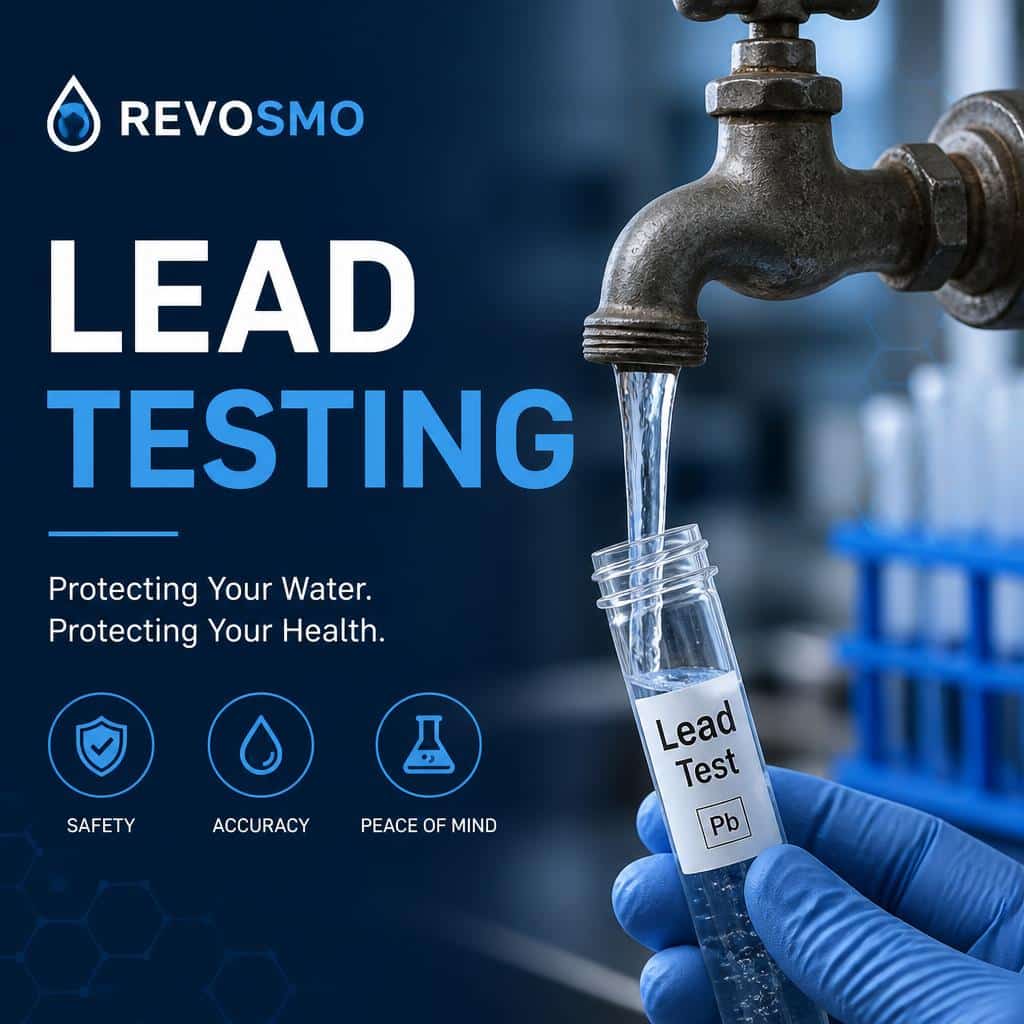
Lead Testing: Lead in drinking water is a serious concern because you cannot see, smell, or taste dissolved lead. The only reliable way to determine whether lead is present in your home’s drinking water is to have the water tested.
Lead can enter tap water when plumbing materials containing lead corrode. Potential sources include lead service lines, older plumbing, faucets, fixtures, solder, and other components. Even homes without a lead service line can potentially have lead introduced by household plumbing. (US EPA)
The good news is that homeowners have several ways to investigate potential lead exposure, including checking their water utility’s information, identifying plumbing materials, collecting a properly prepared water sample, and sending that sample to a certified laboratory.
This guide explains how lead testing works, when you should test, how to collect a sample, how to interpret your results, and what to do if lead is detected.
Table of Contents
- What Is Lead in Drinking Water?
- How Does Lead Get Into Drinking Water?
- Why Should You Test Your Water for Lead?
- Who Should Test for Lead?
- When Should You Test Your Drinking Water?
- How to Test Your Water for Lead
- Lead Water Test Kits vs. Laboratory Testing
- How to Collect a Lead Water Sample
- Where to Send Your Water Sample
- How Much Does Lead Testing Cost?
- How to Read a Lead Test Result
- What If Lead Is Detected?
- How to Reduce Lead in Drinking Water
- Can a Water Filter Remove Lead?
- Does Reverse Osmosis Remove Lead?
- Frequently Asked Questions
- Final Thoughts
What Is Lead in Drinking Water?
Lead is a naturally occurring metal that has historically been used in plumbing materials, paints, batteries, and numerous industrial applications.
In drinking water, the primary concern is lead that enters water through plumbing materials.
Lead can enter water when plumbing components containing lead corrode. The amount that enters the water can be affected by factors such as water chemistry, acidity, mineral content, temperature, and how long water has been sitting in the plumbing. (US EPA)
Lead is particularly concerning because exposure can affect the nervous system and other parts of the body. Children are especially vulnerable to the effects of lead exposure.
The EPA and CDC state that there is no known safe blood lead level for children. (US EPA)
How Does Lead Get Into Drinking Water?
There are several potential sources of lead in residential drinking water.
Lead Service Lines
A lead service line is a pipe connecting a property to the public water main.
Lead service lines can be a significant source of lead in drinking water where they are present. EPA estimates that millions of lead service lines remain in use across the United States. (US EPA)
Older communities and homes are more likely to have plumbing materials containing lead, although the age of a house alone cannot determine whether lead is present.
Faucets and Fixtures
Lead can also come from:
- Faucets
- Brass fixtures
- Chrome-plated brass fixtures
- Pipe fittings
- Plumbing components
Even if the service line entering your property is not made from lead, household plumbing can still be a potential source. (CDC)
Lead Solder
Older plumbing systems may contain solder that contains lead.
When water remains in contact with plumbing for extended periods, lead can potentially leach into the water.
Private Wells
Private well owners should also consider lead testing.
Lead can originate from plumbing, pumps, fittings, and other components associated with a private well system. CDC recommends testing private well water for lead when there is a potential source of contamination. (CDC)
Why Should You Test Your Water for Lead?
Testing is important because lead cannot be detected by looking at or tasting your water.
Clear water is not necessarily lead-free.
EPA states that testing is the only sure way to determine whether harmful quantities of lead are present in drinking water. (US EPA)
A lead water test can help you:
- Determine whether lead is present
- Identify potential exposure from household plumbing
- Establish a baseline for your water quality
- Determine whether treatment may be appropriate
- Verify the performance of a lead-reduction filter
- Investigate an older home’s plumbing
- Evaluate private well water
- Make informed decisions about plumbing replacement
For a broader overview of household water testing, see Revosmo’s How to Test Your Drinking Water.
Who Should Test for Lead?
Lead testing can be appropriate for many homeowners, but certain situations deserve particular attention.
Homes With Older Plumbing
If your home was built many decades ago, its plumbing may contain older materials that warrant investigation.
However, the construction date alone cannot tell you whether lead is present.
Homes With Lead Service Lines
If your water utility identifies your property as having a lead service line, testing your tap water is especially important.
Contact your water provider to find out whether they have information about the service line serving your property. EPA recommends contacting your water utility regarding lead service line information. (US EPA)
Homes Undergoing Plumbing Work
Construction, plumbing repairs, or service-line replacement can disturb existing plumbing materials.
If you have concerns about lead during or after plumbing work, contact your water utility or qualified plumbing professional for guidance.
Private Well Owners
Private well owners should consider testing if their plumbing, pump, or other components could introduce lead into the water.
Families With Young Children
Because children are particularly vulnerable to lead exposure, households with young children may want to be especially proactive about identifying potential sources of lead.
When Should You Test Your Drinking Water?
There is no single testing schedule that applies to every home.
Consider testing when:
- You move into an older home.
- You discover a lead service line.
- Your utility identifies lead plumbing in your neighborhood.
- You replace or modify plumbing.
- You have a private well with potential lead-containing components.
- You notice changes in water quality after plumbing work.
- Your local water authority recommends testing.
- You want to establish a baseline measurement.
If your first test detects lead, additional testing may be appropriate to better understand whether the result is isolated or representative.
How to Test Your Water for Lead
The most reliable approach is to have a properly collected water sample analyzed by a certified drinking-water laboratory.
A typical process looks like this:
Step 1: Contact Your Water Utility
Ask whether your property has:
- A lead service line
- A galvanized service line
- Unknown service-line material
- Known lead plumbing
- Local lead-testing programs
Your utility may also provide sampling bottles or testing assistance.
Step 2: Find a Certified Laboratory
Choose a laboratory certified to analyze drinking water for lead.
EPA encourages individuals seeking independent drinking-water analysis to contact a state-certified drinking-water laboratory. (US EPA)
Step 3: Follow the Laboratory’s Sampling Instructions
Lead sampling procedures matter.
Do not simply fill a random container from your faucet and assume the result will provide an accurate assessment.
The laboratory should provide specific instructions about:
- Which container to use
- Which faucet to sample
- Whether the sample should be first-draw
- How long water should sit before sampling
- Sample volume
- Preservation
- Shipping or delivery
Step 4: Submit the Sample
Return the sample according to the laboratory’s instructions.
Step 5: Review the Results
Your laboratory report should identify the lead concentration and the units used.
Lead Water Test Kits vs. Laboratory Testing
Consumers may encounter inexpensive home lead test kits, but homeowners should understand the difference between screening and laboratory analysis.
Home Test Kits
Advantages can include:
- Low cost
- Convenient
- Quick screening
- Easy to use
However, test kits may have limitations in sensitivity, accuracy, or interpretation.
Laboratory Testing
A certified laboratory provides a more appropriate approach when you need a reliable measurement of lead in drinking water.
EPA recommends sending residential drinking-water samples to a certified laboratory for lead analysis. (US EPA)
Best Approach
If you have a serious concern about lead exposure, don’t rely exclusively on a low-cost home screening kit.
Use a certified laboratory and follow its sampling protocol.
How to Collect a Lead Water Sample
Lead testing requires careful sample collection.
One important distinction is between a first-draw sample and a flushed sample.
First-Draw Sampling
A first-draw sample is collected after water has remained in the plumbing for a specified period.
This type of sample can help identify lead that may have accumulated in water while it was sitting in contact with household plumbing.
Flushed Sampling
A flushed sample is collected after running the water for a specified period.
This can provide different information about water quality and potential plumbing sources.
Which One Should You Use?
Follow the laboratory’s instructions and your local water authority’s sampling protocol.
Do not substitute your own procedure because changing the sampling method can change the result.
EPA notes that water sampling results can vary depending on factors such as sampling time, season, collection method, water flow, and other conditions. (CDC)
Where to Send Your Water Sample
Look for a state-certified drinking-water laboratory that specifically analyzes samples for lead.
Your state drinking-water authority or local water utility can often provide a list of laboratories.
EPA maintains information about state certification programs and certified drinking-water laboratories. (US EPA)
When comparing laboratories, ask:
- Are you certified to test drinking water for lead?
- What analytical method do you use?
- What is your reporting limit?
- Do you provide sampling bottles?
- Do you provide first-draw sampling instructions?
- How quickly must samples be returned?
- How are results reported?
How Much Does Lead Testing Cost?
The cost of a lead water test varies by laboratory and location.
EPA has indicated that residential lead testing may cost roughly $20 to $100, although actual prices can vary. (US EPA)
Some utilities and local programs may offer free or subsidized testing.
Before ordering a test, check with:
- Your water utility
- Your state drinking-water agency
- Your local health department
- Certified laboratories in your area
You may be able to obtain testing at little or no cost through a local program.
How to Read a Lead Test Result
Lead results are commonly reported in:
micrograms per liter (µg/L)
For water, this is numerically equivalent to:
parts per billion (ppb)
For example:
| Lead Result | Equivalent |
| 1 µg/L | 1 ppb |
| 5 µg/L | 5 ppb |
| 10 µg/L | 10 ppb |
| 15 µg/L | 15 ppb |
| 50 µg/L | 50 ppb |
Your laboratory report may also show:
- Detection limit
- Reporting limit
- Method
- Sample date
- Sample location
- Result
- Units
Don’t Focus Only on One Number
Lead test results need to be interpreted in context.
A result can vary depending on how and when the sample was collected. For example, a first-draw sample may produce a different result from a flushed sample.
If you receive a result that concerns you, discuss it with your water utility, state health department, certified laboratory, or qualified water professional.
What If Lead Is Detected?
If lead is detected in your drinking water, take the result seriously but don’t panic.
Start by determining where the lead may be coming from.
1. Contact Your Water Utility
Ask about:
- Your service-line material
- Local lead testing
- Corrosion-control treatment
- Lead service-line replacement
- Recommended flushing procedures
2. Investigate Household Plumbing
Potential sources include:
- Service lines
- Faucets
- Fixtures
- Solder
- Pipe fittings
- Older plumbing
3. Consider Retesting
A follow-up test may help determine whether the original result is representative.
Use the same sampling procedure when comparing tests whenever possible.
4. Use Appropriate Treatment
If lead is present, consider a treatment system specifically certified or documented for lead reduction.
5. Address the Source
Removing or replacing a lead source is often the most direct long-term solution when feasible.
EPA emphasizes identifying and replacing lead service lines as an important way to reduce exposure. (US EPA)
How to Reduce Lead in Drinking Water
If you are concerned about lead, there are several practical steps you can take while investigating the source.
Use Cold Water for Drinking and Cooking
Use cold tap water for drinking, cooking, and preparing infant formula.
Hot tap water can contain higher concentrations of lead because heat can increase the release of lead from plumbing.
Flush Stagnant Water
If water has been sitting in household plumbing for an extended period, flushing the plumbing can reduce water that has been in prolonged contact with potential lead sources.
However, flushing recommendations vary depending on the plumbing configuration and service line.
Contact your water utility for specific guidance. (US EPA)
Clean Faucet Aerators
Particles can accumulate in faucet aerators.
Cleaning them periodically can help remove accumulated sediment and particles.
Use a Certified Filter
If treatment is necessary, select a point-of-use filter specifically certified to reduce lead.
CDC recommends looking for appropriate independent certification, including NSF/ANSI standards applicable to lead reduction. (CDC)
Replace Lead Plumbing
Where feasible, permanently removing the source is preferable to relying exclusively on treatment.
Can a Water Filter Remove Lead?
Yes, some water filters are specifically designed and certified to reduce lead.
However, not every water filter removes lead.
When shopping for a filter, look for:
- Lead reduction certification
- Independent certification
- Clearly stated contaminant-reduction claims
- Appropriate replacement-filter requirements
The CDC recommends choosing a treatment system based on the contaminants actually present in your water. (CDC)
A filter should not be selected simply because its marketing says it removes “impurities.”
Does Reverse Osmosis Remove Lead?
Reverse osmosis can reduce lead from drinking water, but the specific system should be evaluated based on its documented performance and certification.
RO systems use a semipermeable membrane to reduce many dissolved contaminants.
For households concerned about lead and other dissolved contaminants, an under-sink RO system can provide treated water at a dedicated drinking-water faucet.
However, an RO system is generally a point-of-use solution, not automatically a whole-house solution.
For more information about RO technology, system configurations, filtration stages, and maintenance, see Revosmo’s The Ultimate Guide to Reverse Osmosis Systems.
The CDC recommends testing your water first and choosing a treatment system that specifically addresses the contaminants you are concerned about. (CDC)
Lead Testing Checklist
Use this checklist if you’re concerned about lead in your drinking water:
- Check your local water-quality report.
- Contact your water utility.
- Ask about your service-line material.
- Determine whether your home has older plumbing.
- Identify potential lead-containing fixtures.
- Find a certified drinking-water laboratory.
- Follow the laboratory’s sampling instructions.
- Collect the sample correctly.
- Send the sample to the laboratory.
- Review the laboratory report.
- Retest if appropriate.
- Select treatment based on your results.
- Consider replacing the source of lead.
- Test again after treatment or plumbing replacement when appropriate.
Frequently Asked Questions
How do I test my tap water for lead?
The most reliable approach is to collect a water sample according to a certified laboratory’s instructions and have it analyzed by a certified drinking-water laboratory.
Can I see or taste lead in water?
No. Dissolved lead cannot reliably be detected by sight, taste, or smell. Testing is necessary to determine whether lead is present. (US EPA)
How often should I test my water for lead?
There is no universal schedule for every household. Testing may be appropriate when moving into an older home, discovering a lead service line, changing plumbing, receiving information about local lead contamination, or whenever your water utility recommends testing.
Does boiling water remove lead?
No. Boiling water does not remove lead. EPA specifically advises that boiling should not be used as a method for removing lead from drinking water. (US EPA)
Does a Brita-style filter remove lead?
Some consumer filters are certified to reduce lead, while others are not. Check the specific product’s certification and performance claims rather than assuming that all carbon filters remove lead.
Does reverse osmosis remove lead?
Many RO systems can reduce lead, but performance varies by system. Choose an RO system with appropriate third-party certification or documented lead-reduction performance.
Can lead enter water from a faucet?
Yes. Faucets and fixtures can be sources of lead, particularly older brass or chrome-plated brass components. (CDC)
Should I test my well water for lead?
If you have a private well and there is a potential source of lead in the well, pump, plumbing, or fixtures, testing is worthwhile. CDC recommends using an approved sampling protocol and a certified laboratory. (CDC)
What is a safe level of lead in drinking water?
Lead exposure should be minimized, particularly for children. Regulatory requirements and action levels for public water systems are not the same thing as a guarantee that a particular household tap contains no lead. If your household test detects lead, consult your water utility or appropriate health authority for current guidance.
Final Thoughts
Lead testing is one of the most important drinking-water tests a homeowner can perform when lead exposure is possible.
Because lead cannot be seen, tasted, or smelled, testing is the only dependable way to determine whether it is present in your home’s drinking water.
Start by contacting your water utility and finding out what is known about your service line and local water system. Then, if appropriate, use a state-certified drinking-water laboratory and carefully follow its sampling instructions.
If lead is detected, investigate the source and consider certified filtration, plumbing repairs, or lead service-line replacement as appropriate.
For a complete overview of residential water testing—including when to test, what to test for, and how to interpret results—continue to Revosmo’s How to Test Your Drinking Water guide.
If you are considering reverse osmosis as part of your drinking-water treatment strategy, see The Ultimate Guide to Reverse Osmosis Systems.
Important: This article provides general educational information and is not a substitute for advice from your water utility, state health department, certified laboratory, physician, or qualified water professional. Lead regulations and recommendations can change, so always use current local and federal guidance when making decisions about drinking-water safety.