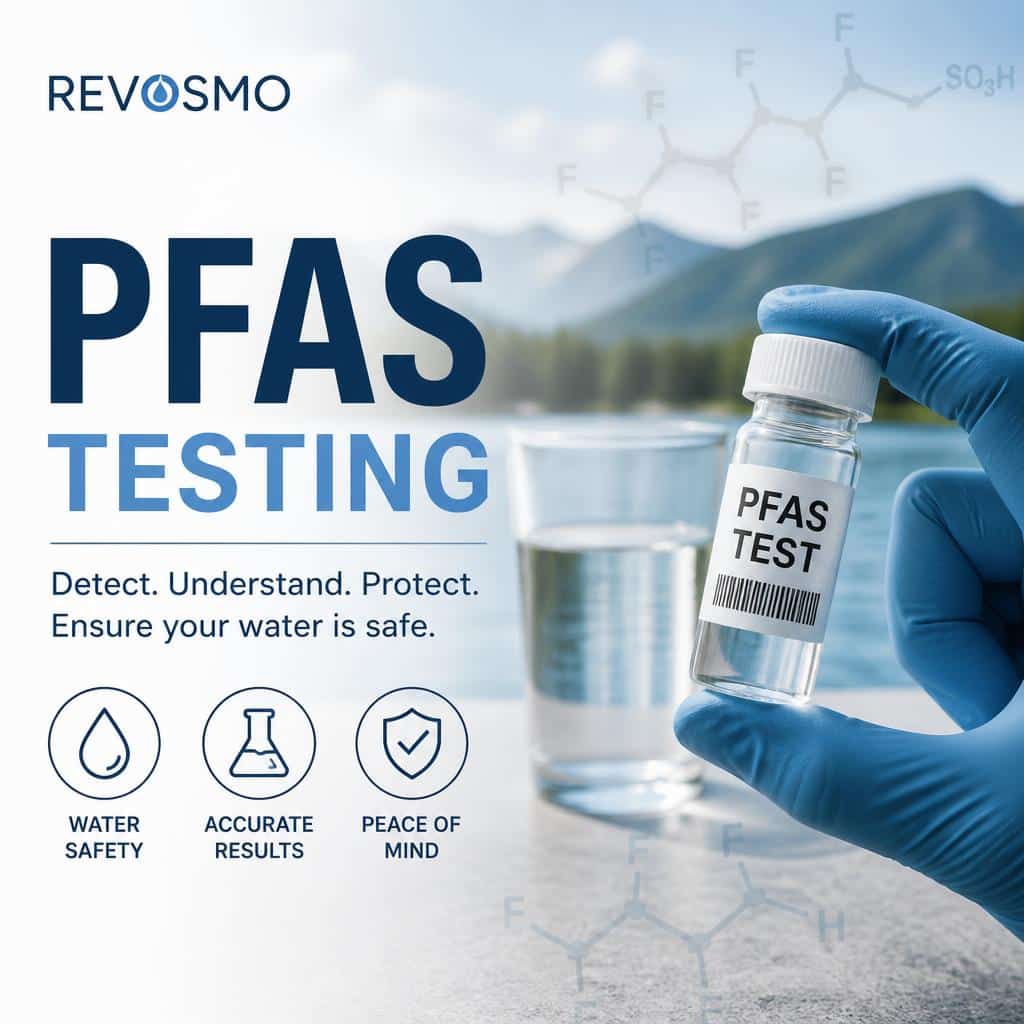
PFAS Testing: Per- and polyfluoroalkyl substances, commonly called PFAS, are a large group of manufactured chemicals that have been used in industrial processes and consumer products for decades. Because many PFAS compounds persist in the environment, they are often called “forever chemicals.”
PFAS can enter drinking-water supplies from industrial facilities, firefighting-foam use, landfills, consumer products, and other sources. Testing your drinking water is the best way to determine whether PFAS are present in your home’s water.
Unlike some basic home water tests, accurate PFAS testing generally requires laboratory analysis using highly sensitive analytical methods. The U.S. Environmental Protection Agency (EPA) has developed specific methods for measuring PFAS in drinking water, including EPA Methods 533 and 537.1. Together, these methods can measure 29 different PFAS compounds. (US EPA)
This guide explains how PFAS testing works, what to test for, how to collect a sample, how to interpret your results, and what you can do if PFAS are detected.
Table of Contents
- What Are PFAS?
- Why Test Your Drinking Water for PFAS?
- How Do PFAS Get Into Drinking Water?
- Who Should Consider PFAS Testing?
- How Is PFAS in Water Tested?
- EPA Methods 533 and 537.1
- How to Collect a PFAS Water Sample
- Where to Get a PFAS Water Test
- How Much Does PFAS Testing Cost?
- How to Read a PFAS Test Report
- What Do PFAS Test Results Mean?
- What If PFAS Are Detected?
- Can Reverse Osmosis Remove PFAS?
- PFAS Filtration and Treatment Options
- Frequently Asked Questions
- Final Thoughts
What Are PFAS?
PFAS stands for per- and polyfluoroalkyl substances.
PFAS are a large family of manufactured chemicals with properties that make them resistant to heat, oil, grease, stains, and water. These properties have made PFAS useful in numerous industrial and consumer applications. (US EPA)
Commonly discussed PFAS include:
- PFOA
- PFOS
- PFHxS
- PFNA
- PFBS
- HFPO-DA, commonly associated with GenX chemicals
There are thousands of PFAS compounds, but drinking-water testing typically focuses on a defined group of compounds that can be reliably measured using validated analytical methods.
Because PFAS can persist in the environment, contamination can remain in groundwater and drinking-water sources long after the chemicals were originally released.
Why Test Your Drinking Water for PFAS?
You cannot reliably determine whether PFAS are present based on taste, odor, color, or appearance.
PFAS contamination may be present even when water looks and tastes completely normal.
Testing can be particularly useful if:
- Your water utility has reported PFAS detections.
- You live near a known PFAS contamination site.
- Your property is near an industrial facility.
- Your area has a history of firefighting-foam use.
- You rely on a private well.
- Your local groundwater has known contamination.
- You are concerned about PFAS exposure.
- You want to verify the performance of a PFAS treatment system.
Testing should be viewed as part of a broader drinking-water evaluation rather than as a replacement for your local water-quality report.
For a complete overview of drinking-water testing, see Revosmo’s How to Test Your Drinking Water.
How Do PFAS Get Into Drinking Water?
PFAS can reach water supplies through a variety of pathways.
Potential sources include:
Industrial Facilities
Manufacturing and industrial operations have historically used PFAS in certain processes and products.
Firefighting Foam
Certain types of firefighting foam have been an important source of PFAS contamination, particularly around airports, military facilities, industrial sites, and firefighting training areas.
Landfills
PFAS-containing consumer and industrial products can contribute to contamination when they enter landfills.
Consumer Products
PFAS have been used in products designed to resist water, grease, stains, and heat.
Contaminated Groundwater
Once PFAS enter groundwater, they can migrate through an aquifer and potentially reach drinking-water sources.
Who Should Consider PFAS Testing?
Anyone can test their drinking water for PFAS, but testing may be especially worthwhile for households with specific reasons for concern.
Municipal Water Customers
If you receive water from a city or other public water system, start by checking your utility’s water-quality information.
Your utility may already be monitoring for PFAS or may have information about PFAS levels in the source water.
A household test can provide additional information about the water coming from your own tap.
Private Well Owners
Private wells deserve special consideration because they generally do not receive the same routine regulatory monitoring as public water systems.
If PFAS contamination is known or suspected in your area, consider having your well tested by a qualified laboratory.
Homes Near Potential PFAS Sources
Testing may also make sense if your property is near:
- Airports
- Military installations
- Industrial facilities
- Fire-training facilities
- Landfills
- Known contaminated sites
Local and state environmental agencies may have information about known PFAS contamination in your area.
How Is PFAS in Water Tested?
PFAS testing is different from many basic household water tests.
A typical water-quality test kit might allow you to measure pH, chlorine, hardness, or other basic characteristics at home.
PFAS testing requires much more sensitive analytical equipment.
Laboratories use techniques such as liquid chromatography combined with tandem mass spectrometry (LC-MS/MS) to identify and quantify PFAS at very low concentrations.
EPA’s validated drinking-water methods include Method 533 and Method 537.1. (US EPA)
This is why a homeowner should generally choose a qualified laboratory rather than relying on a simple color-changing strip or handheld meter.
EPA Methods 533 and 537.1
EPA has developed analytical methods specifically for measuring PFAS in drinking water.
EPA Method 533
Method 533 uses isotope dilution and liquid chromatography/tandem mass spectrometry to measure selected PFAS in drinking water.
It is particularly useful for measuring additional PFAS compounds, including several shorter-chain substances.
EPA Method 537.1
Method 537.1 is another validated drinking-water method using solid-phase extraction and LC-MS/MS.
The method measures a different group of PFAS compounds.
Why the Method Matters
PFAS is not a single chemical.
A laboratory report that says “PFAS tested” does not necessarily mean that every possible PFAS compound was analyzed.
EPA states that Methods 533 and 537.1 together can effectively measure 29 unique PFAS compounds in drinking water. (US EPA)
When comparing laboratory testing options, look at the actual analyte list and analytical method rather than simply choosing a test labeled “PFAS.”
How to Collect a PFAS Water Sample
PFAS sampling requires more care than many routine household water tests.
The laboratory should provide detailed sampling instructions and the appropriate sample containers.
A typical process involves:
- Order a PFAS drinking-water test from a qualified laboratory.
- Follow the laboratory’s sampling instructions exactly.
- Use only the containers supplied or approved by the laboratory.
- Avoid contaminating the sample.
- Collect the sample from the specified tap.
- Record the collection date and time.
- Complete the laboratory paperwork.
- Ship or deliver the sample according to the laboratory’s instructions.
Why Sampling Matters
PFAS testing involves extremely low concentrations.
Contamination introduced during collection, handling, transportation, or laboratory processing can affect results.
EPA’s PFAS research resources specifically address sampling protocols associated with drinking-water PFAS methods. (US EPA)
Important: Always follow the laboratory’s current sampling instructions instead of improvising your own collection procedure.
Where to Get a PFAS Water Test
The best starting point is a state-certified drinking-water laboratory that offers PFAS analysis.
EPA encourages individuals who want independent drinking-water testing to contact a state-certified drinking-water laboratory. (US EPA)
When comparing laboratories, ask:
- Does the laboratory test drinking water for PFAS?
- Which EPA method is used?
- Which PFAS compounds are included?
- What is the laboratory’s reporting limit?
- Is the laboratory certified or accredited for the applicable drinking-water analysis?
- Does the laboratory provide sampling containers?
- How should the sample be collected?
- How quickly must the sample be returned?
- How are results reported?
A laboratory that cannot clearly explain its PFAS testing methodology may not be the best choice.
How Much Does PFAS Testing Cost?
PFAS testing costs vary considerably depending on:
- Number of PFAS compounds tested
- Analytical method
- Laboratory
- Detection/reporting limits
- Sampling requirements
- Turnaround time
- Additional contaminants included in the package
A basic water test can be inexpensive, but PFAS analysis is generally more specialized and expensive because it requires sophisticated laboratory equipment.
Before ordering a test, compare the analyte list, detection limits, methodology, and total price rather than choosing strictly on cost.
How to Read a PFAS Test Report
A PFAS laboratory report may contain several important pieces of information.
Analyte
The specific PFAS compound being tested.
Examples include:
- PFOA
- PFOS
- PFHxS
- PFNA
- PFBS
- HFPO-DA
Result
The measured concentration in the sample.
Units
PFAS results are often reported in extremely small concentrations.
A common unit is:
ng/L — nanograms per liter
For water, 1 ng/L is equivalent to approximately 1 part per trillion (ppt).
Reporting Limit
The lowest concentration the laboratory can reliably report under the applicable analytical conditions.
Non-Detect
A result may be reported as “ND” or “not detected.”
This does not necessarily mean that absolutely no PFAS is present.
It generally means the compound was not detected above the laboratory’s reporting or detection limit.
What Do PFAS Test Results Mean?
Interpreting PFAS results requires looking at:
- Which PFAS were detected?
- At what concentrations?
- What analytical method was used?
- What was the laboratory reporting limit?
- Is the result being compared with a federal or state standard?
- Is the result from a public water system or a private household sample?
For example, EPA’s federal PFAS drinking-water regulation establishes maximum contaminant levels for PFOA and PFOS at 4.0 parts per trillion, along with limits for certain other PFAS and a hazard-index approach for specified PFAS mixtures. (EPA NPI)
Regulatory requirements can change, and state requirements may differ from federal requirements. Therefore, homeowners should check current EPA and state guidance when interpreting results.
A laboratory result should not be interpreted solely by looking for a number and assuming that any detection automatically means the water is unsafe.
What If PFAS Are Detected?
If your test detects PFAS, don’t panic.
Instead, take a systematic approach.
Step 1: Verify the Result
Review the laboratory report carefully.
Confirm:
- The correct sample was analyzed.
- The laboratory used an appropriate drinking-water method.
- The analyte list is clear.
- The reporting limits are provided.
If the result is unexpected or potentially significant, consider discussing additional testing with the laboratory or appropriate water-quality professional.
Step 2: Check Your Water Source
If you receive municipal water, contact your water utility.
Ask about:
- PFAS monitoring
- Recent test results
- Source-water information
- Treatment processes
- Known contamination
- Any planned treatment upgrades
Step 3: Consider Retesting
A second test can help determine whether the initial result was representative.
This can be particularly useful when a result is unexpected or close to a regulatory threshold.
Step 4: Investigate Treatment
If PFAS are consistently detected, research treatment technologies specifically certified or rated for PFAS reduction.
Can Reverse Osmosis Remove PFAS?
Reverse osmosis can be an effective treatment technology for reducing many PFAS compounds, but homeowners should select a system based on verified performance claims rather than assuming that every RO system removes PFAS equally.
The CDC recommends choosing a home treatment system based on the specific chemicals or germs present in your water and checking the product’s certification or performance claims. (CDC)
For PFAS treatment, look for a system whose certification or manufacturer documentation specifically addresses PFAS reduction.
Revosmo’s The Ultimate Guide to Reverse Osmosis Systems provides a broader explanation of RO technology, system types, filtration stages, maintenance, and purchasing considerations.
PFAS Filtration and Treatment Options
Several treatment technologies may be used to reduce PFAS in drinking water.
Reverse Osmosis
RO systems force water through a semipermeable membrane that can reject many dissolved contaminants.
For a household concerned primarily about drinking and cooking water, a point-of-use RO system can be a practical treatment approach when the specific system has appropriate PFAS reduction claims or certification.
Activated Carbon
Certain activated-carbon filters can reduce PFAS.
Performance varies according to:
- Carbon type
- Filter design
- PFAS compound
- Contact time
- Water chemistry
- Filter capacity
- Maintenance
Whole-House Treatment
Whole-house treatment may be appropriate when PFAS reduction is needed for water throughout the home.
However, the treatment strategy should be based on the actual contamination level and intended use of the water.
Certification Matters
Do not choose a filter simply because the product description says it “removes PFAS.”
Look for appropriate third-party certification and documented performance for PFAS reduction.
The CDC specifically advises consumers to check that a treatment system removes the contaminants of concern. (CDC)
Should You Test Before Buying a PFAS Filter?
Yes, whenever practical.
Testing first can help you:
- Determine whether PFAS are present.
- Identify which compounds were detected.
- Establish a baseline.
- Compare treatment options.
- Verify treatment performance afterward.
It also prevents you from purchasing a treatment system based solely on assumptions about your water.
A good approach is:
Test → Understand → Treat → Retest
That sequence can give homeowners much more confidence in their water-treatment decisions.
Frequently Asked Questions
Can I test for PFAS at home?
Most reliable PFAS testing requires laboratory analysis rather than a simple consumer test strip. EPA has validated specific analytical methods for measuring PFAS in drinking water. (US EPA)
What is the best test for PFAS in drinking water?
Look for a laboratory that performs drinking-water PFAS analysis using an appropriate validated method, such as EPA Method 533 or Method 537.1.
How many PFAS can be detected in drinking water?
EPA states that Methods 533 and 537.1 together can effectively measure 29 unique PFAS compounds. (US EPA)
What does ND mean on a PFAS test?
“ND” generally means the compound was not detected above the laboratory’s applicable detection or reporting limit. It does not necessarily mean the concentration is exactly zero.
What unit is PFAS measured in?
PFAS concentrations in drinking water are commonly reported in nanograms per liter (ng/L), which is equivalent to parts per trillion (ppt) for water.
Does boiling water remove PFAS?
Boiling should not be relied upon as a method for removing PFAS from drinking water.
Does reverse osmosis remove PFAS?
Reverse osmosis can reduce many PFAS compounds, but performance varies by system and contaminant. Choose a system with specific, verified PFAS-reduction claims or certification.
Do water filters remove PFAS?
Some activated-carbon and reverse-osmosis systems can reduce PFAS. However, not every water filter is designed or certified for PFAS reduction.
Should I test my well water for PFAS?
If you have a private well and live in an area with known or suspected PFAS contamination, testing may be worthwhile. State and local environmental or health agencies can provide information about known contamination in your area.
Final Thoughts
PFAS testing is an important part of understanding drinking-water quality when there is a reason to suspect PFAS contamination.
Because PFAS can occur at extremely low concentrations, reliable testing requires appropriate laboratory methods and careful sample handling. EPA Methods 533 and 537.1 provide validated approaches for measuring PFAS in drinking water. (US EPA)
For homeowners, the most practical strategy is straightforward:
Test your water → understand the results → choose treatment based on the contaminant → verify treatment performance.
If you are beginning a broader evaluation of your home’s drinking water, start with Revosmo’s How to Test Your Drinking Water guide.
If PFAS or other dissolved contaminants are detected and you are considering reverse osmosis, continue with Revosmo’s The Ultimate Guide to Reverse Osmosis Systems.
Important: PFAS regulations and health guidance can change. Always compare your test results with current federal and state requirements and consult your water utility, state health/environmental agency, or qualified water-quality professional when appropriate.